
Cups are the basis of being able to cook and bake. Whether you are mixing up your grandmother’s legendary cookies or tackling a new recipe from your favorite food blog, precise measurements are a crucial factor in the difference between kitchen success and disaster.
Every home cook can relate to how it feels when a recipe goes wrong. Technique isn’t always to blame (or lack of quality ingredients) — it is often just improperly measuring your ingredients! Chefs and cooking magazines agree that nothing takes the joy out of cooking quite like uneven ingredients!
The Importance of Good Kitchen Tools For Every Cook
Solid measuring cups and spoons are about much more than replacing your hands as ingredient holders. They maintain consistency, minimize waste, and allow you to duplicate successful dishes over and over. These must-have cooking accessories are the backbone of your baking essentials; designed for repeated use.
Just imagine: would you build a house without a level? Like measuring without instruments, measuring without a ruler can cause the same kinds of trouble. Your cookies might spread too much, your bread might not rise, or your soup could be too salty.
Good kitchen tools save money, too. Cheap measuring cups are frustrating to use and usually break, lose their calibration, or both long before you’d expect to have to go through this whole process again. For more quality kitchen essentials and tools, visit https://dtdfhomeandkitchen.com/ to find products that will serve reliably for years.
The Science Behind Accurate Measurements
Baking in particular requires precision because it’s really chemistry. Excess flour leads to dense, dry outcomes. Too little liquid means you don’t get the same kind of binding. Even tiny measurement errors multiply into large texture and flavor issues.
Professional bakers weigh ingredients for greater accuracy. Volume measurements using good measuring cups are fine for home cooking when you use them properly.
Different ingredients react differently when they are measured. Flour becomes compacted, sugar clumps and liquids create a meniscus curve. Understanding these behaviors will enable you to use your measurement tools to their fullest.
Best Measuring Cups and Spoons for Your Kitchen
1. OXO Good Grips 4-Piece Measuring Cup Set
- Material: BPA free plastic, non-slip handles
- Available in sizes: 1/4 cup, 1/3 cup, 1/2 cup and 1 cup
- Price Range: $15-20
These measuring cups have easy-to-read measurement markings that will not fade. The easy handles make holding them very easy even when wet. Stackable design saves drawer space.
The angled markings make measurements easy to read when looking from above. Dishwasher-safe construction makes cleanup effortless.
Good for: Everyday cooking, liquid-based ingredients, busy kitchens
2. All-Clad Stainless-Steel Measuring Cups and Spoons Set
- Material: 18/10 stainless steel
- Available sizes: 1/4 cup, 1/3 cup, 1/2 cup, and 1 cup
- Price Range: $40-50
These measuring cups will last for decades because they’re made of professional-grade stainless steel. The mirror polished finish is not just for elegant look but also its long-lasting scratch resistant quality.
The uniform load distribution allows for more stability when measuring. Rolled edges prevent dripping and allow for smooth pouring. These cups work for both wet and dry ingredients.
Best for: Baking enthusiasts, industrial kitchens, serious home cooks
3. Pyrex Glass Measuring Cup Set
- Material: Tempered glass
- Sizes: 1 cup, 2 cups, 4 cups, 8 cups
- Price Range: $25-35
Heatproof glass enables you to measure hot liquids without having to worry about cracking. Transparent construction lets you see food levels from any angle. Microwave-safe construction allows for melting butter or heating liquids.
The spout design makes for easy, non-drip pouring. Red easy-to-read measurement markings are easy to read from the inside, too.
Best for: Liquids, heating, visibility needs
4. Joseph Joseph Nest Measuring Cups
- Material: BPA-free plastic
- Sizes: 1/4 cup, 1/3 cup, 1/2 cup, 1 cup
- Price Range: $20-25
Creative nesting design will save you more than 50% more storage space than other sets. Color-coded system avoids confusion during busy cooking times. Non-skid bases keep cups in place on countertops.
Easy-to-grip handles offer comfort for long use. The snap-together feature ensures the set stays together in drawers or cabinets.
Best for: Small kitchens, neatness lovers, contemporary design aficionados
5. Cuisipro Stainless Steel Measuring Spoons
- Material: Stainless steel with silicone handles
- Available sizes: 1/4 tsp, 1/2 tsp, 1 tsp, 1 tbsp
- Price Range: $15-20
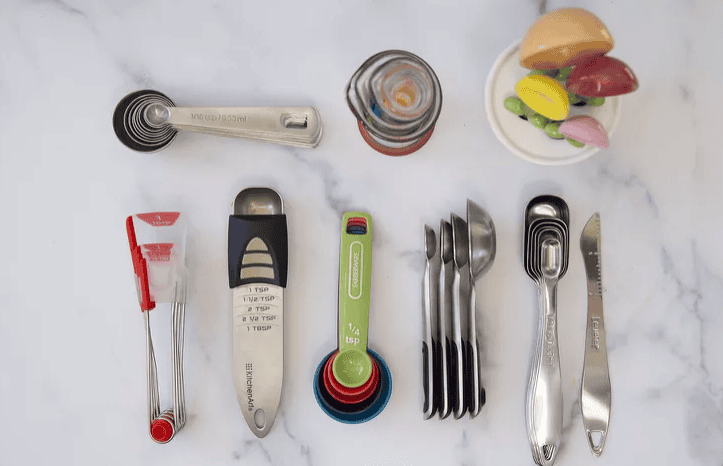
These measuring spoons have narrow bowls so you can scoop out the ingredient you need without getting it on your countertop. Two-ended design offers both round and oval bowls for multiple ingredients.
The magnetic feature prevents the spoons from coming apart when stored. Etched measurements will not fade away and are built to last, ensuring greater readability for a long time.
Best for: Measuring spices, space-saving, professional accuracy
6. KitchenAid Plastic Measuring Cup Set
- Material: BPA-free Tritan plastic
- Sizes: 1/4 cup, 1/3 cup, 1/2 cup, 1 cup
- Price Range: $12-18
Tough Tritan plastic won’t stain, hold odors, or crack. These cups do not become cloudy over time. Handles are designed for easy, comfortable no-slip grip and are very easy to pour.
Multiple measurements allow for measurements in both metric and imperial. Lightweight construction minimizes hand strain while you cook.
Good for: Budget-minded cooks, daily use, metric conversions
7. Nordic Ware Aluminum Measuring Cups
- Material: Cast aluminum
- Sizes: 1/4 cup, 1/3 cup, 1/2 cup, 1 cup
- Price Range: $18-25
Constructed from high-quality aluminum then anodized for durability. You will not crack, chip or break these measuring cups under normal kitchen use. Natural aluminum finish will patina and gain character over time.
Long handles make it easy to use and stay cool; great leverage for scooping. Wide rims allow for easy and precise leveling of dry ingredients.
Ideal for: Commercial applications, heavy use, traditional look
8. Progressive Magnetic Measuring Spoons
- Material: Stainless steel
- Sizes: 1/8 tsp, 1/4 tsp, 1/2 tsp, 1 tsp, 1/2 tbsp, 1 tbsp
- Price Range: $10-15
Complete set includes all commonly used spoon sizes. Powerful magnets hold spoons together for easy storage. Flat bottoms allow the spoons to stand on the counter.
Two-sided measurements with one side in standard and the other in metric. Round bowls are great for liquids; square ones are better for dry ingredients.
Best for: Full measurement coverage, magnetic storage, versatility
Key Attributes to Consider in High-Quality Measuring Instruments
Accuracy and Consistency
Professional measuring cups require extreme accuracy. Choose tools with measurements that are certified or endorsed by professionals. For consistent results, you need to measure the same way every time.
Test new measuring cups by comparing them against a kitchen scale. Good tools should be within a few grams of the expected weight figures.
Durability and Construction
Select ones that hold up to everyday wear and tear. Stainless steel is the most durable, but also the most expensive. Quality plastic offers value if treated right.
Check handle attachments carefully. Weak connection points usually give out first and the set becomes useless.
Easy-to-Read Markings
Permanent, legible markings eliminate guesswork to prevent errors in measurement. Choose those with etched or molded, rather than printed, measurements that may wear off. Multiple measurement systems add versatility.
When selecting measuring cups, think of your kitchen lighting. Contrast between markings and material helps with accuracy in different lighting conditions.
Storage and Organization
Nested sets save space. Magnetic spoons stay together naturally. Ring holders work well, but you need to dedicate drawer space.
What kind of kitchen organizer are you? Some cooks want everything in plain sight; others prize storage that’s as compact as possible.
Proper Measuring Techniques for Different Ingredients
Dry Ingredients
Spoon dry ingredients into measuring cups (do not pack). Level off any extra with a straight edge such as the back of a knife. Never tap the cups or shake them down to settle ingredients.
Not all dry ingredients are created the same way. Brown sugar requires packing and flour should be light and airy.
Liquid Ingredients
Place measuring cups on flat surfaces to measure properly. Read measurements at eye level where the liquid meets the curve of the meniscus. Pour slowly to avoid overflow.
Check the temperature of hot liquids to make sure they don’t exceed the cup’s limits. Glass measuring cups are better for hot liquids than plastic measuring cups.
Sticky Ingredients
When measuring honey, molasses, or peanut butter, spray measuring cups with cooking oil so ingredients won’t stick to the cup. This method is effective and makes for easy removal and accurate measurement.
Alternatively, measure oil first, and then use the same measuring cup for sticky ingredients. The oil residue creates natural stick prevention. You can find more tips on proper measuring techniques at America’s Test Kitchen.
Maintenance and Care for Longer Tool Life
Cleaning Best Practices
Hand washing is recommended to extend the life of measurement markings. Use warm soapy water and gentle sponges that won’t scratch them. Dry completely to avoid water spots.
Stainless steel measuring cups can be cleaned vigorously if necessary. Plastic tools need more gentle care to keep them clear and transparent.
Storage Solutions
Always wash and dry your measuring cups and spoons before putting them away to avoid mold or rust. Organize similar items together for convenient cooking.
Avoid stacking different materials together. Metal scratches plastic and sharp corners may damage softer materials.
When it’s Time for New Measuring Tools
Replace measuring cups if the markings become unreadable or if they lose accuracy. Cracks, breaks, or warping can distort measurements.
Commercial kitchens typically replace measuring utensils annually. Home cooks can expect their tools to last several years when properly cared for.
Budget-Friendly Options vs Premium Choices
Affordable Alternatives
Plastic measuring cup sets typically cost between $8-12 to start. These are sufficient for occasional baking and common cooking requirements. Focus on clear markings and durable construction.
Restaurant supply shops often offer professional-grade tools at reasonable prices. These choices balance durability and price very well.
Investment-Worthy Premium Sets
A good set of measuring cups will cost about $30-$60, but will last for decades. Professional-level accuracy and durability justify the higher prices for serious cooks.
Consider how often you cook. People who bake daily get more value from top-end tools than home cooks who only bake occasionally.
Cost-Benefit Analysis
Calculate cost per year of use, not just the initial price. A $50 set that lasts 20 years is cheaper per year than a $15 set that you replace every 3 years.
Good measuring cups often come with warranties, protecting your initial investment.
Common Measuring Mistakes to Avoid
Overpacking Dry Ingredients
Packing flour into measuring cups can give you 25% more ingredient than needed. This extra amount is crucial to texture and flavor in baked goods.
Spoon and level flour every time for consistent results.
Inconsistent Leveling
Different methods of leveling cause measurement variations. Pick one approach and use it consistently.
Keep a straight-edge tool specifically for leveling measurements.
Wrong Tool Selection
Liquid measuring cups and dry measuring cups are not interchangeable. Using the inappropriate type results in significant errors.
Have both types ready for comprehensive cooking.
Frequently Asked Questions
What’s the Difference Between Dry and Liquid Measuring Cups?
Dry measuring cups are meant to be filled completely and leveled off. Liquid measuring cups come with a pouring spout and extra room above the measurement lines to avoid spilling. Using the proper type ensures accurate measurements.
How often should I replace my measuring cups?
Good measuring cups can last 10-20 years with reasonable use. Replace when the markings are no longer visible, when they are cracked or warped, or when measurement discrepancies are evident in your cooking.
Is it worth spending money on expensive measuring cups?
Higher quality measuring cups offer increased accuracy, durability, and better materials. For avid bakers and those who cook often, the investment pays dividends in consistent results and long service. Casual home cooks can get decent results from mid-range models.
Can I use the same measuring cups for wet and dry ingredients?
While possible, it’s not ideal. Wet ingredients can leave residue that affects dry ingredient measurements. Many professional kitchens have separate sets, but home cooks can manage with thorough washing between uses.
What is the best material for measuring cups?
All materials have benefits: stainless steel is durable, glass offers visibility and heat resistance, and quality plastic provides convenience and affordability. Choose according to your cooking style and budget.
How can I measure sticky ingredients without mess?
Spray measuring cups with cooking spray or measure oil first, then use the same cup for sticky ingredients. The oil coating helps ingredients release cleanly with minimal residue.
Should measuring spoons nest together?
While nesting spoons are convenient for storage, they can sometimes be difficult to separate quickly while cooking. Some cooks prefer individual spoons for quick access. Choose based on your kitchen storage and cooking habits.
How can I tell if my measuring cups are accurate?
Test volume measurements with water (1 cup of water should weigh about 240g). A good set of measuring cups will measure within 2-3% of the expected weight.
Building Your Ideal Kitchen Arsenal
The measuring tools you choose will transform your cooking from guesswork into science. These basic kitchen devices deserve the same serious consideration you would give to knives or pans when assembling a kitchen.
Start with a basic set that serves your immediate needs. As your confidence grows, you can add specialty tools, such as adjustable measuring cups or mini measuring spoons for small quantities.
Remember: The best measuring cups are those you will actually use regularly. Consider your cooking methods, space, and budget before deciding. Invest in quality baking accessories that will help you achieve consistent results with your favorite recipes and dishes.
Whether you choose a budget-friendly plastic set or splurge on professional-grade stainless steel, look for tools that are accurate, durable, and easy to use. Your future culinary achievements will thank you for making smart choices now.
Great cooking begins with precise measuring. Get these must-have cooking tools working in your kitchen, and you’ll be amazed at how much your results improve! After all, the accomplished home chef understands that precise measurement leads to excellence on the plate.