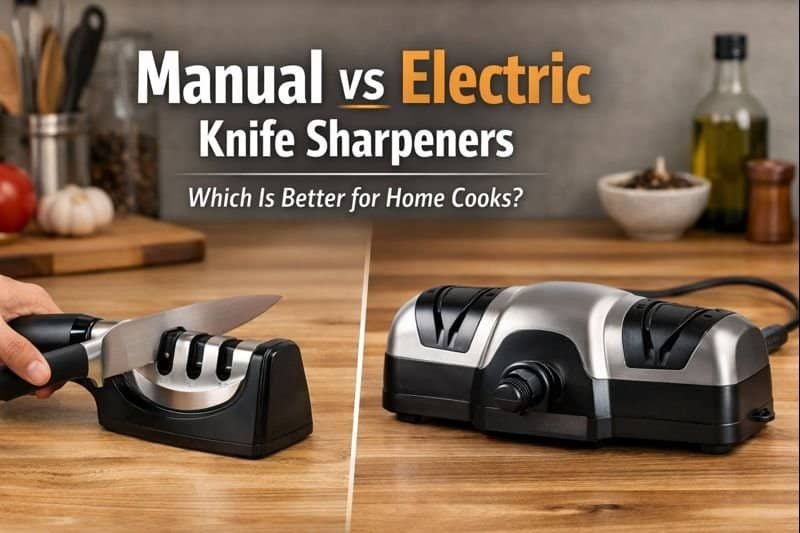
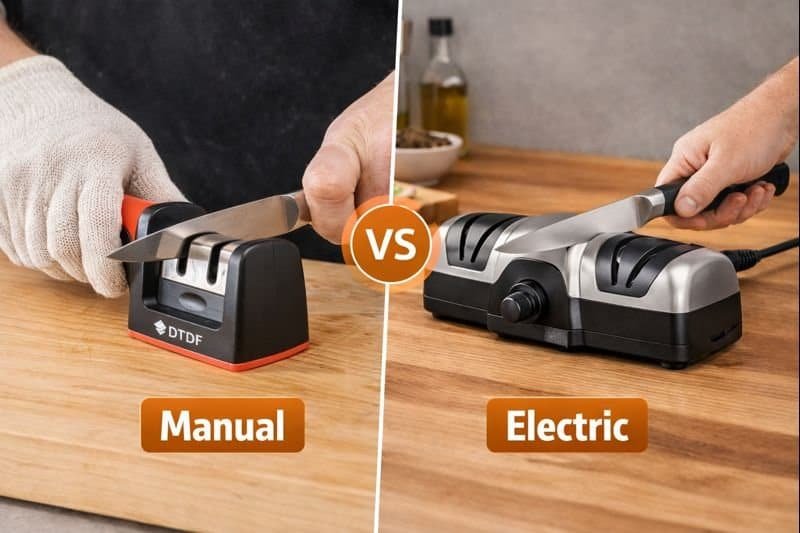
Manual vs electric knife sharpeners is a common comparison for home cooks who want sharper knives but aren’t sure which tool is safer or more practical for everyday use. Both options can restore a dull blade, but they work differently and suit different kitchen habits.
Instead of asking which one is “best” overall, it’s more useful to ask which one is better for your cooking style, safety comfort level, and maintenance routine. This guide explains the real differences so you can make a confident, informed choice.
Many people focus on tool choice, but overlook the bigger safety issue that dull blades are often more dangerous than sharp ones. (Read: Why Dull Knives Are Dangerous)
How Manual Knife Sharpeners Work
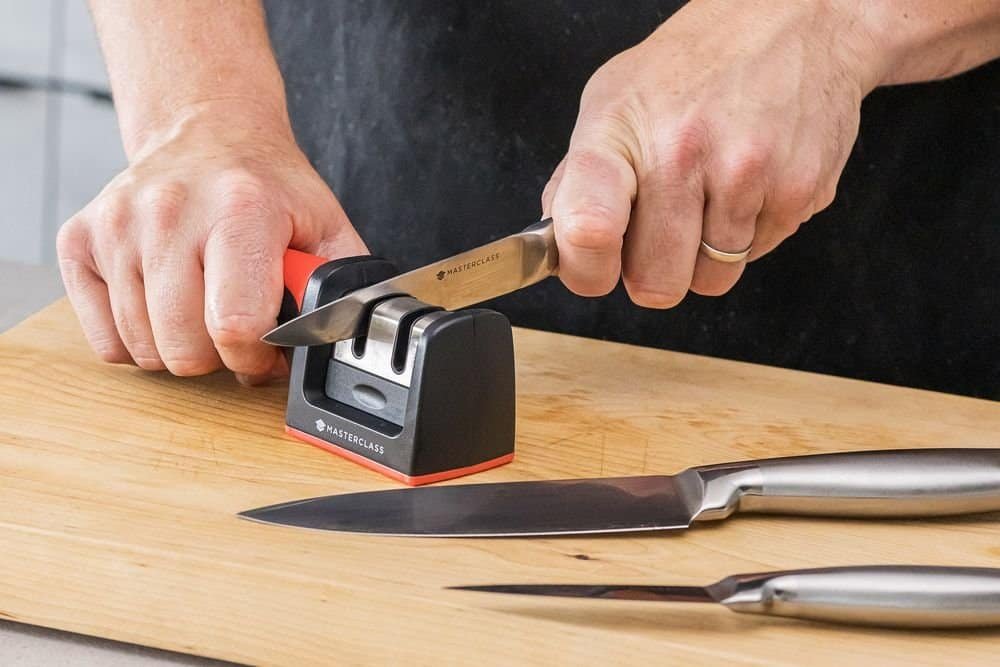
Manual sharpeners use fixed abrasive slots that guide the blade at a consistent angle. You pull the knife through each slot in sequence, usually from coarse to fine, to restore and refine the edge.
Most manual systems are designed for simplicity and control. They remove less material per pass and allow the user to move slowly and deliberately. Because there’s no motor, you control the speed and pressure entirely.
For many households, manual sharpeners are used as part of a regular maintenance routine rather than a one-time fix for severely dull knives. They’re typically compact, affordable, and easy to store, which makes them practical for everyday kitchens. Manual systems are often preferred by cautious users who feel unsure about sharpening tools at first. (See: Why Knife Sharpening Feels Scary)
How Electric Knife Sharpeners Work
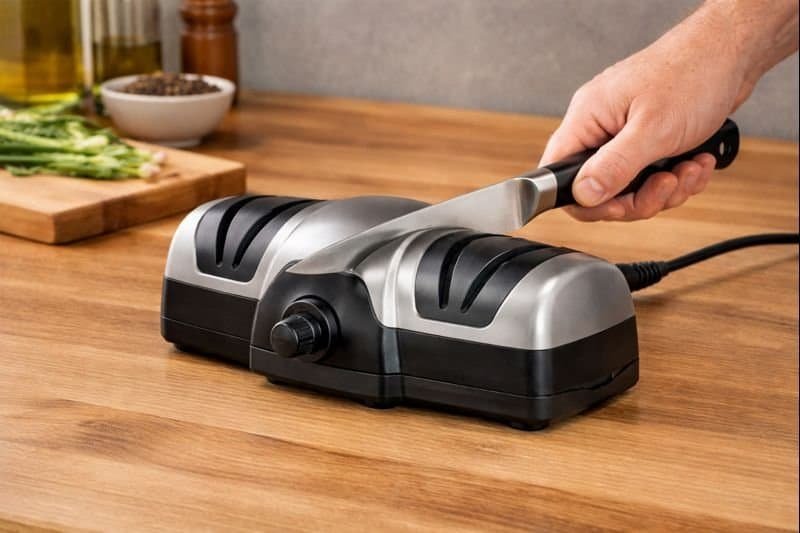
Electric sharpeners use motor-driven abrasive wheels or belts to sharpen the blade. Instead of pulling the knife through by hand, the machine spins the sharpening surface and removes material more quickly.
The main advantage is speed and convenience. With minimal effort, a dull knife can be restored in a short time. Many electric models also include angle guides, so users don’t need to think about positioning.
However, because they remove metal faster, electric sharpeners can be more aggressive on the blade if overused. They also tend to be larger, louder, and more expensive than manual options. For some users, the speed is helpful for others, it feels less controlled.
Manual vs Electric Knife Sharpeners: Key Differences
When comparing manual vs electric knife sharpeners, the most important differences are not just speed but control, material removal, and user confidence.
Manual sharpeners offer slower, more controlled sharpening. They’re quieter, portable, and usually easier for cautious users to manage. Because each stroke is guided by hand, many people feel more aware of what the blade is doing.
Electric sharpeners prioritize speed and convenience. They’re useful when knives are very dull or when time is limited. But the faster grinding action means more metal can be removed in a short period, which makes technique and frequency more important.
There’s also a comfort factor. Some home cooks prefer the hands-on control of a manual tool, while others prefer letting a machine do the work. Many manual systems use staged slots here’s a full explanation of how 3-stage knife sharpeners work and when they make sense.
Which Is Better for Most Home Cooks?
For most home cooks, a manual sharpener is often the better starting point. It supports a maintenance mindset, encourages slower handling, and reduces the chance of over-sharpening. It’s also typically more affordable and easier to use in small kitchens.
Electric sharpeners are often better suited to households that cook frequently, use knives heavily, or want fast results with minimal effort. They can be helpful for restoring very dull blades, provided they are not used too aggressively or too often.
Skill level also matters. Beginners who are safety-focused often feel more comfortable starting with manual systems. Users who value speed and convenience may lean toward electric models.
Safety and Blade Care Considerations
Safety isn’t just about the sharpening tool it’s about how it’s used. Manual systems encourage slower movement and lighter pressure, which can support safer habits. Electric systems reduce manual effort but require attention to avoid removing too much material too quickly.
Blade longevity is another factor. Knives last longer when sharpened gradually and maintained regularly, rather than being aggressively ground after long neglect. In that sense, the best tool is often the one you’ll use consistently and correctly.
Protective gloves, stable surfaces, and controlled strokes matter with both types. If you’re unsure about correct technique, this step-by-step guide explains how to sharpen kitchen knives safely at home
When Each Type Makes Sense
A manual sharpener makes sense when:
- You prefer control over speed
- You maintain knives regularly
- You want a simple, low-risk system
- You have limited kitchen space
An electric sharpener makes sense when:
- Knives are frequently very dull
- You want faster sharpening
- You cook heavily and often
- Convenience is your priority
Neither tool is universally better the right choice depends on your kitchen habits.

Final Verdict
In the manual vs electric knife sharpeners debate, there isn’t a single winner for every home. Manual sharpeners offer control, simplicity, and maintenance-friendly use. Electric sharpeners offer speed and convenience when used responsibly.
For most households, the better option is the one that supports regular, safe knife care because consistent maintenance matters more than sharpening speed.