

The kitchen is often called the heart of the home, and for good reason. It’s where meals are prepared, families gather, and memories are made. But a truly functional kitchen is about more than just stylish finishes; it’s about a layout that works for you, minimizing wasted steps and maximizing efficiency.
Choosing the right kitchen layout is arguably the most critical decision in your design or renovation journey. It dictates everything from how smoothly your cooking tasks flow to how easily people can move through the space. Let’s dive into the most common kitchen layouts, explore their unique benefits and considerations, and help you find the perfect blueprint for your dream kitchen.
The Work Triangle: The Foundation of Kitchen Efficiency
Before we explore specific layouts, it’s essential to understand the Work Triangle. This classic design principle connects the three primary workstations in any kitchen: the sink, the refrigerator, and the cooking zone (stove/oven). The goal is to arrange these three points in a triangle with optimal distances, allowing for smooth, uninterrupted movement between them during meal preparation.
- Ideal Distances: Each leg of the triangle should ideally be between 4 and 9 feet. The sum of all three legs should be between 12 and 26 feet.
- No Obstructions: The path between any two points of the triangle should be clear of islands, peninsulas, or other major obstructions.
- Beyond the Triangle: While crucial, modern kitchens often expand this concept to “work zones” (e.g., a baking zone, a cleaning zone, a prep zone) to accommodate more complex culinary needs or multiple users.
Understanding the Work Triangle helps ensure your chosen layout isn’t just beautiful, but also incredibly practical.
Common Kitchen Layouts: Which One Is Right For You?
Let’s break down the most popular kitchen layouts and their respective strengths and weaknesses.
1. The L-Shape Kitchen
Description: Characterized by two adjacent walls forming an “L” shape. Ideal For: Medium to large spaces, open-plan homes, families who want a flexible design.
- Pros:
- Versatile: Easily incorporates a dining area or island.
- Open Feel: Keeps the kitchen open to adjacent rooms, fostering connection.
- Efficient Work Triangle: Often allows for an uncluttered and highly functional work triangle.
- Good for Socializing: Leaves space for multiple people to move and interact without crowding the cook.
- Cons:
- Corner Storage: Can have challenging corner storage unless clever solutions are used (e.g., lazy Susans, pull-out shelves).
- Long Walks: In very large “L”s, the distance between appliances might become too long.
2. The U-Shape Kitchen

Description: Features three walls of cabinets and appliances, forming a “U.” Ideal For: Medium to large kitchens, serious cooks, those who need maximum counter space and storage.
- Pros:
- Maximum Countertop & Storage: Offers the most continuous counter space and cabinet storage among standard layouts.
- Highly Efficient Work Triangle: The enclosed nature naturally creates a very tight and efficient work triangle.
- Dedicated Workspace: Creates a distinct, dedicated area for cooking activities, minimizing through-traffic.
- Cons:
- Can Feel Enclosed: In smaller spaces, it might feel a bit cramped or cut off from other living areas.
- Two Corner Cabinets: You’ll have two corner cabinets to contend with, requiring smart storage solutions.
- Limited Traffic Flow: Generally not ideal for kitchens with heavy through-traffic.
3. The Galley Kitchen
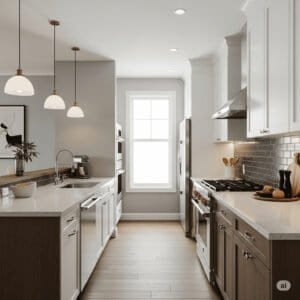
Description: Consists of two parallel walls, creating a central walkway. Ideal For: Smaller spaces, apartments, single cooks, or homes where efficiency is paramount.
- Pros:
- Highly Efficient: Often considered the most efficient layout due to the close proximity of workstations.
- Minimal Footprint: Excellent for narrow spaces, maximizing vertical storage.
- Cost-Effective: Typically requires less cabinetry and countertop material than larger layouts.
- Cons:
- Limited Space: Can feel cramped, especially with multiple people.
- Through-Traffic Issues: If it’s a main thoroughfare, it can interrupt the cook’s workflow.
- Less Social: Not ideal for large gatherings or social cooking.
4. The Island Kitchen (with L, U, or Galley base)

Description: Adds a freestanding island unit to an existing L-shape, U-shape, or even a larger galley kitchen. Ideal For: Larger kitchens, entertainers, families, those needing extra prep, storage, or dining space.
- Pros:
- Increased Functionality: Provides additional counter space for prep, a secondary sink, or even a cooktop.
- Social Hub: Islands are natural gathering points for guests or family members.
- Extra Storage: Offers valuable cabinet or drawer space underneath.
- Flexible Seating: Can incorporate bar stools for casual dining or a breakfast nook.
- Cons:
- Requires Space: An island needs adequate clearance around all sides (at least 36-48 inches) for proper flow.
- Can Disrupt Flow: If too large or poorly placed, it can obstruct the work triangle.
- Cost: Adds to the overall budget for materials and installation.
5. The Peninsula Kitchen

Description: Similar to an island, but attached to a wall or existing cabinetry at one end, forming a “G” shape with other walls. Ideal For: Medium-sized kitchens that need added counter space and social functionality but lack room for a full island.
- Pros:
- Extra Counter & Storage: Provides additional workspace and storage like an island, but in a smaller footprint.
- Defined Zones: Can create a natural division between the kitchen and other living areas without fully enclosing the space.
- Casual Seating: Excellent for adding breakfast bar seating.
- Cons:
- Less Flexible: Attached to a wall, so it’s less flexible in terms of placement than an island.
- Traffic Flow: Depending on placement, it can sometimes restrict access or create bottlenecks.
Key Considerations When Choosing Your Layout
Beyond the basic types, several factors will influence your final layout decision:
- Your Lifestyle: Do you cook every day or occasionally? Do you entertain often? Do you have young children or pets?
- Kitchen Size & Shape: Measure accurately and consider architectural elements like windows and doorways.
- Plumbing & Electrical: Moving major utilities like sinks, dishwashers, and ovens can significantly increase costs. Work with existing rough-ins if possible to save budget.
- Traffic Flow: Ensure clear pathways around appliances and through the kitchen.
- Natural Light: Position workstations to take advantage of natural light where possible.
- Adjacency to Other Rooms: How does the kitchen connect to dining areas, living rooms, or outdoor spaces?
Bringing Your Layout to Life
Once you’ve settled on a potential layout, visualize it. Use masking tape on the floor to map out appliances and cabinets. Walk through your daily routine. Does it feel intuitive? Are there any bottlenecks?
Designing your dream kitchen layout is an exciting journey that blends practicality with personal preference. By understanding the core principles of the work triangle and exploring the strengths of each common layout, you’re well on your way to creating a kitchen that’s not just a space, but a perfectly engineered hub for your home.