
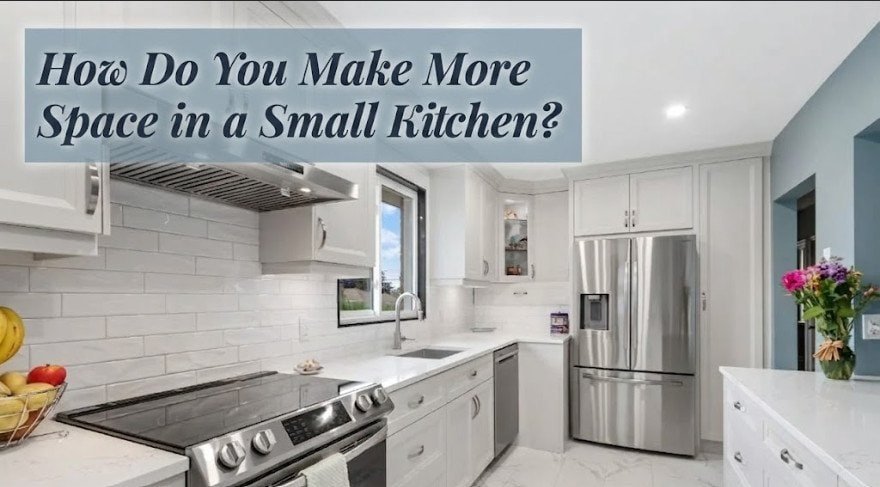
Plenty of tenants and homeowners find their small kitchens too cramped to use comfortably, and the first instinct is usually to knock down a wall to reconfigure the floor plan, or save up to move somewhere with a bigger kitchen entirely.
Most people fall into the same cognitive trap here: the actual problem with a small kitchen is rarely a genuine lack of space. It’s a lack of systematic planning. Knocking down walls or moving house is both expensive and, for most ordinary families, simply not realistic financially or logistically.
Dtdf Home and Kitchen has sorted through years of reader submissions and renovation cases and found a consistent pattern: most small kitchens have unused vertical space and dead zones behind doors, while their cabinets stay stuffed with redundant, rarely used tools.
Two widespread misconceptions are worth unpacking first, since clearing them up unlocks a surprising amount of storage potential without any actual modification to the property, which matters given that renters can’t alter existing decor in the first place.
MISCONCEPTION ONE: SMALL KITCHENS NEED FEWER APPLIANCES
Plenty of people believe owners of small kitchens have to give up countertop appliances entirely, treating stand mixers and food processors as tools exclusive to larger homes. In reality, storing four small appliances inside the pull-out shelves of an appliance cabinet takes up less total space than leaving a single air fryer sitting out on the counter year-round. The actionable version of this follows a logic of vertical stacking, under-cabinet mounting, and matching rolling carts.

One boundary worth drawing clearly: a 60-square-foot narrow kitchen genuinely can’t fit a deep fryer, a stand mixer, and a full-size food processor all out at once. That’s a rotation and planning problem, though, not proof that small kitchens can’t support quality appliances at all.
MISCONCEPTION TWO: VERTICAL SPACE DOESN’T COUNT
Many people measure their kitchen’s size purely by countertop and floor square footage, and never factor in the three-dimensional, cubic-foot space sitting above it. Tools that fit a no-renovation requirement here include magnetic knife racks, hanging rods with S-hooks, and stackable shelf inserts for cabinets.
A common mistake pairs badly with this oversight: using valuable vertical space to store unused holiday dinnerware, while daily-use items get crammed into already overcrowded drawers.
Vertical space is actually the highest-quality storage real estate a small kitchen has. The guiding principle worth holding onto is simple: reserve the accessible core work zone for high-frequency items first, and never let low-frequency clutter, the stuff pulled out a few times a year, occupy that prime, within-reach space.
FIVE UNDERUSED STORAGE SPOTS IN MOST SMALL KITCHENS
Five types of storage space go underused in nearly every small kitchen: the top of the refrigerator, the inside of cabinet doors, the gap between the fridge and the wall or countertop, the back corners of deep cabinets, and the area under the sink.
Of these, the under-sink area is the most persistent pain point. Blocked by pipes and irregularly shaped, it turns into a messy dead zone almost by default. Layered storage racks built to work around the pipes, or stackable wheeled bins, handle this reasonably well. Dtdf Home and Kitchen’s overview of under-sink storage tools covers specific product options for anyone tackling this space directly.
It’s worth being upfront that no storage trick works universally. A single-row, I-shaped kitchen and an L-shaped kitchen follow completely different spatial logic, so not every method transfers cleanly between the two. Anyone restructuring their overall layout can check the site’s in-depth breakdown of kitchen layouts and workflows before committing to a specific plan.
WHY MOST DRAWER STORAGE FAILS
Fixed drawer storage tools tend to fail for one consistent reason: they don’t match how the household actually cooks. The only storage logic that holds up long-term is sorting by frequency of use rather than forcing items into place by category. Daily-use tools belong in the top drawer nearest the stove, while weekly or occasional items move to drawers farther away. Adjustable divider tools fit this logic far better than fixed alternatives. Dtdf Home and Kitchen’s guide to drawer storage tools breaks down specific options worth considering here.

Two mainstream types of drawer tools each carry tradeoffs. Fixed tray inserts install quickly and give a neat initial partition, but their size is locked in, which means oddly shaped tools like spatulas and ladles often don’t fit, and spacing can’t adjust to actual usage habits over time. Adjustable divider systems flex to fit the size of different tools and adapt to a household’s real cooking workflow, though they typically cost more upfront and take a bit longer to configure correctly the first time.
WHY COUNTERTOPS FEEL CRAMPED EVEN WHEN THEY AREN’T
The cramped feeling in most small kitchens comes from visible clutter, not from an actual lack of area. The real logic of space organization was never about buying a large volume of storage tools. It’s about strictly controlling what types and quantities of items ever land on the countertop in the first place.
Two low-cost, no-renovation examples illustrate this well. Swapping scattered fresh fruit for a single layered fruit basket costing a small amount clears up a surprising amount of visual space. Replacing a floor-standing paper towel holder with a wall-mounted one does the same for floor clutter. Individually, upgrades like these cost very little. Added together, they noticeably change how a small kitchen feels to cook in day to day.
FREQUENTLY ASKED QUESTIONS
Is a rolling kitchen cart worth buying if floor space is tight?
Only if there’s a fixed, measured gap to place it in permanently, such as beside the fridge or at the end of a counter run. Measure the gap before buying, since a cart that gets moved around constantly creates more hassle than it solves.
Should duplicate kitchenware from friends or family be thrown out?
For a small kitchen, keeping one sentimental duplicate is enough. The space freed up by extra identical spatulas or measuring cup sets can go toward genuinely essential items instead.
What’s the most efficient plan on a limited budget?
A magnetic knife rack paired with a hanging rod is the standout choice here. It’s low-cost, and the space it frees up outperforms most other storage products at a similar price point.
Is an over-the-sink cutting board actually useful, or just a gimmick?
It earns its keep only in kitchens with genuinely minimal countertop space, since it adds a temporary work surface that folds away after use. Kitchens with adequate counter space don’t need it.
What if the kitchen still feels cluttered after organizing everything?
Move the last few exposed items into cabinets or drawers. A clear countertop improves the sense of space more than almost any other single change.
Anyone planning a kitchen reorganization from scratch can pair this guide with the site’s 11 field-tested small kitchen tips, and UK renters specifically may also find the storage hacks guide built for small UK homes useful alongside it, since both stick to the same principle: adaptability and low cost over buying storage products just for the sake of it.