
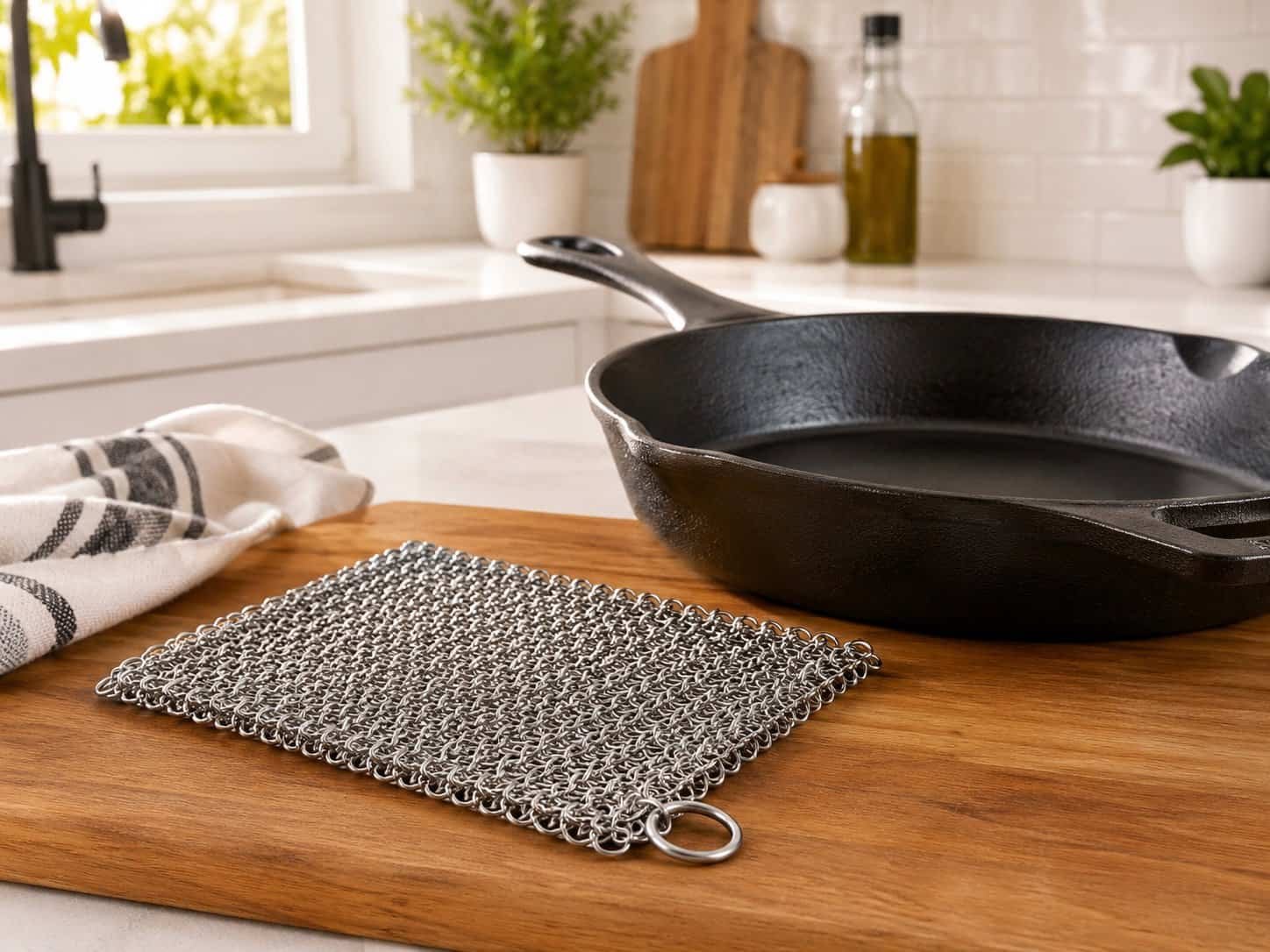
A cast iron scrubber is one of the simplest yet most effective tools for keeping cast iron cookware clean without relying on harsh abrasives or disposable cleaning products. Whether you use a cast iron skillet every day or occasionally cook with a Dutch oven or grill pan, removing burnt-on food while preserving the cookware’s seasoned surface can be challenging. A quality cast iron scrubber helps lift stubborn food residue efficiently, making routine cookware maintenance quicker and easier.
Cast iron cookware has remained a favourite in kitchens for generations because of its excellent heat retention, durability, and ability to develop a naturally non-stick cooking surface when properly seasoned. However, even the best-maintained cookware requires the right cleaning technique and the right tools to keep it performing at its best.
Unlike ordinary kitchen sponges, chainmail-style cast iron scrubbers use interlocking stainless steel rings that help loosen baked-on food and grease while remaining durable enough for repeated use. Their reusable design, ease of maintenance, and effectiveness on heavy-duty cookware have made them increasingly popular with both home cooks and outdoor cooking enthusiasts.
Despite their growing popularity, many people still have important questions. What is a cast iron scrubber? How does it work? Can it scratch cookware? Does it remove seasoning? Can it be used on other types of cookware?
This comprehensive guide answers those questions and many more. You’ll learn how cast iron scrubbers work, how to use and maintain them correctly, which cookware they are suitable for, common mistakes to avoid, and what to look for before buying one. Whether you’re new to cast iron cooking or looking to improve your cookware care routine, this guide will help you get the most from your cast iron scrubber.
What Is a Cast Iron Scrubber?

A cast iron scrubber is a reusable kitchen cleaning tool, typically made from food-grade stainless steel chainmail rings, that removes stuck-on food and cooking residue from cast iron cookware without unnecessarily damaging a well-seasoned cooking surface. It cleans durable cookware efficiently and can last for years with proper care.
What Exactly Is a Cast Iron Scrubber?
A cast iron scrubber is a specialised cleaning tool developed for one purpose: removing stubborn food residue from cast iron cookware without relying on harsh abrasives or disposable scouring pads. Although it looks simple, its unique chainmail construction allows it to tackle baked-on grease, burnt food, and cooking residue that ordinary kitchen sponges often struggle to remove.
Unlike traditional wire wool or steel wool, which uses fine metal fibres, manufacturers make cast iron scrubbers by linking hundreds of smooth, rounded stainless steel rings into a flexible mesh. This chainmail design allows the scrubber to move across the surface of cast iron cookware while lifting food particles rather than aggressively grinding against the metal.
Because the rings are smooth rather than sharp, a cast iron scrubber cleans by applying controlled friction to loosen residue. When used correctly, it removes food debris while helping preserve a properly developed seasoning layer.
Why Is It Called a Chainmail Scrubber?
The scrubber takes its name from traditional chainmail armour because craftsmen linked thousands of metal rings together to create a flexible protective fabric. Manufacturers use the same principle to produce modern cast iron scrubbers, but they make them from food-grade stainless steel specifically for kitchen use.
This flexible chainmail structure offers several practical advantages:
- It bends easily around the curved sides of skillets and Dutch ovens.
- It reaches textured cooking surfaces more effectively than flat sponges.
- It applies even cleaning pressure across the cookware.
- It remains durable even after frequent use.
Rather than acting like sandpaper, the interlocking rings work together to dislodge burnt food while minimising unnecessary wear on the cooking surface.
What Is a Cast Iron Scrubber Made From?
Most high-quality cast iron scrubbers are manufactured from food-grade stainless steel, chosen for its strength, corrosion resistance, and long service life.
A well-made cast iron scrubber typically offers:
| Feature | Why It Matters |
|---|---|
| Food-grade stainless steel | Safe for repeated kitchen use |
| Interlocking chainmail rings | Flexible cleaning without sharp edges |
| Rust-resistant construction | Helps extend the scrubber’s lifespan with proper care |
| Weld-free or smoothly finished rings | Reduces the risk of snagging during cleaning |
| Reusable design | Eliminates the need for disposable scouring pads |
The quality of the stainless steel and the finish of the rings play an important role in how comfortable and effective the scrubber feels during everyday use.
How Is a Cast Iron Scrubber Different from Other Kitchen Cleaning Tools?
Although many kitchen cleaning tools can remove food residue, they are designed for different purposes. Understanding these differences helps you choose the right tool for each cleaning task.
| Cleaning Tool | Best For | Limitations |
|---|---|---|
| Cast iron scrubber | Removing burnt-on food from durable cookware | Not suitable for delicate non-stick coatings |
| Kitchen sponge | Everyday light cleaning | Struggles with stubborn baked-on residue |
| Nylon washing-up brush | Gentle daily cleaning | Less effective on heavily burnt food |
| Plastic pan scraper | Thick food deposits | Limited on textured cooking surfaces |
| Steel wool | Heavy rust removal and restoration | Can remove seasoning and scratch cookware if used incorrectly |
Rather than replacing every cleaning tool in your kitchen, a cast iron scrubber fills a specific role. It is designed for heavy-duty cleaning of robust cookware where ordinary sponges often fall short.
Why Has the Cast Iron Scrubber Become So Popular?
As more people discover the benefits of cast iron cookware, interest in proper cleaning tools has also grown. A cast iron scrubber has become a popular choice because it combines durability, simplicity, and long-term value.
Many home cooks appreciate that it:
- Removes stubborn burnt-on food with less effort.
- Helps maintain well-seasoned cast iron cookware.
- Can be reused for years with proper care.
- Reduces the need for disposable scouring pads.
- Requires very little maintenance.
- Works on several types of heavy-duty cookware.
Its straightforward design also makes it easy to incorporate into everyday kitchen cleaning routines.
DTDF Home & Kitchen Tip
Allow hot cast iron cookware to cool slightly before cleaning. Adding warm water to an extremely hot pan can create thermal stress, while cleaning a pan that is still slightly warm often makes food residue easier to remove with a cast iron scrubber.
Key Takeaways
- A cast iron scrubber is a reusable cleaning tool made from interlocking stainless steel chainmail rings.
- It is designed to remove stubborn food residue from cast iron cookware while helping preserve a well-maintained seasoning layer.
- Its flexible chainmail construction allows it to clean curved and textured cooking surfaces effectively.
- High-quality cast iron scrubbers are typically made from food-grade stainless steel for durability and corrosion resistance.
- Although designed for cast iron, many models are also suitable for other durable cookware such as carbon steel pans, grill pans, and barbecue griddles.
Why Do People Use a Cast Iron Scrubber?
People use a cast iron scrubber because it removes stubborn, burnt-on food more effectively than many traditional kitchen cleaning tools while helping to preserve a properly seasoned cast iron surface. Its durable stainless steel chainmail construction also makes it reusable, easy to maintain, and suitable for cleaning a variety of heavy-duty cookware.
Why Has the Cast Iron Scrubber Become So Popular?
Cleaning cast iron cookware requires a different approach from cleaning standard pots and pans. While many people instinctively reach for an abrasive scouring pad or steel wool, these tools can be unnecessarily aggressive for routine cleaning and may increase the amount of maintenance your cookware requires.
A cast iron scrubber offers a practical alternative. Its flexible chainmail design helps loosen cooked-on food instead of grinding against the surface. This makes everyday cleaning quicker while reducing the need for excessive scrubbing.
As more home cooks discover the benefits of cast iron cookware, chainmail scrubbers have become a popular addition to kitchen cleaning routines because they combine effectiveness, durability, and simplicity.
It Removes Burnt-On Food More Easily
One of the biggest reasons people buy a cast iron scrubber is its ability to tackle stubborn food residue.
After cooking foods such as:
- Steak
- Burgers
- Bacon
- Chicken
- Fried potatoes
- Cornbread
- Roasted vegetables
small amounts of food can become firmly attached to the cooking surface.
Instead of scraping aggressively with metal utensils or repeatedly scrubbing with a sponge, the rounded stainless steel rings help lift the residue gradually while following the contours of the cookware.
For many people, this means:
- Less effort.
- Faster cleaning.
- Better cleaning results.
- Reduced frustration after cooking.
It Helps Preserve a Well-Seasoned Surface
A properly seasoned cast iron pan develops a protective layer created by repeatedly heating thin coats of oil until they bond to the metal.
Many new cast iron owners worry that cleaning will remove this seasoning.
When used correctly, a cast iron scrubber is designed to remove food residue rather than strip away a well-established seasoning layer during routine cleaning.
However, seasoning can become damaged if:
- excessive force is used,
- the seasoning was already weak,
- the cookware has developed rust,
- aggressive abrasive products are used alongside the scrubber.
This is why proper cleaning technique remains just as important as choosing the right cleaning tool.
It Is Built to Last
Unlike disposable scouring pads that wear out quickly, a quality cast iron scrubber is designed for repeated use over a long period.
Because it is manufactured from durable stainless steel chainmail, it does not flatten like sponges or lose bristles like some brushes.
With regular cleaning and proper drying, many cast iron scrubbers remain effective for years.
This long lifespan makes them an economical option for people who cook regularly with cast iron.
It Reduces Household Waste
Many kitchens use disposable cleaning products that require frequent replacement.
Examples include:
- synthetic scouring pads,
- disposable sponges,
- steel wool pads,
- abrasive cleaning blocks.
A reusable cast iron scrubber can replace many of these products for heavy-duty cookware cleaning, helping reduce household waste while lowering long-term replacement costs.
Although it won’t replace every kitchen cleaning tool, it can significantly reduce the number of disposable products needed for cleaning cast iron cookware.
It Works on More Than Just Cast Iron
Despite its name, a cast iron scrubber isn’t limited to cast iron skillets.
Many people also use it on:
| Cookware | Suitable? | Notes |
|---|---|---|
| Cast iron skillets | ✔ Yes | Ideal for everyday cleaning |
| Dutch ovens | ✔ Yes | Suitable for uncoated cast iron |
| Grill pans | ✔ Yes | Helps clean ridged surfaces |
| Carbon steel pans | ✔ Yes | Suitable with proper care |
| Pizza steels | ✔ Yes | Effective for baked-on residue |
| BBQ griddles | ✔ Yes | Useful after outdoor cooking |
| Non-stick cookware | ✘ No | May damage the coating |
| Delicate ceramic coatings | ✘ No | Not recommended |
Its versatility means one cleaning tool can be used across several types of durable cookware.
It Requires Very Little Maintenance
Unlike some kitchen tools that need regular replacement or special cleaning products, maintaining a cast iron scrubber is straightforward.
After use, most manufacturers recommend:
- Rinsing away food particles.
- Washing with warm water and mild washing-up liquid if needed.
- Drying thoroughly before storing.
- Keeping it in a dry place between uses.
This simple routine helps keep the scrubber clean and ready for future use.
DTDF Home & Kitchen Tip
Don’t wait until food residue has completely hardened before cleaning your cookware. Cleaning while the pan is still warm (not piping hot) often makes burnt-on residue easier to remove and reduces the amount of scrubbing required.
Advantages of Using a Cast Iron Scrubber
| Benefit | Why It Matters |
|---|---|
| Removes stubborn food | Less time spent scrubbing |
| Helps preserve seasoning | Supports long-term cookware performance |
| Reusable | Reduces replacement costs |
| Durable | Can last for years with proper care |
| Easy to maintain | Simple cleaning routine |
| Versatile | Suitable for several types of heavy-duty cookware |
| Eco-friendly | Helps reduce disposable cleaning products |
Key Takeaways
- A cast iron scrubber is designed to make cleaning heavy-duty cookware faster and easier.
- It removes stubborn food residue while helping preserve a well-maintained seasoning layer when used correctly.
- Its durable stainless steel construction makes it suitable for long-term, repeated use.
- It can clean several types of robust cookware beyond cast iron, including carbon steel and barbecue griddles.
- Regular cleaning and proper storage help maximise its lifespan and performance.
How Does a Cast Iron Scrubber Work?
A cast iron scrubber works by using hundreds of smooth, interlocking stainless steel rings to loosen and lift burnt-on food from the surface of cast iron cookware. Rather than cutting into the metal, the flexible chainmail moves across the cookware, applying controlled friction that breaks the bond between cooked-on residue and the seasoned cooking surface.
Understanding the Cleaning Process
At first glance, a cast iron scrubber may look too simple to be effective. Unlike brushes with stiff bristles or abrasive scouring pads, it has no sharp edges, scraping blades, or cleaning chemicals. Instead, its effectiveness comes from the way the interlocking chainmail rings interact with food residue.
When food is heated during cooking, proteins, sugars, and fats can bond tightly to the surface of the cookware. Over time, these baked-on deposits become difficult to remove with a soft sponge alone.
As you move a cast iron scrubber across the surface, the rounded stainless steel rings slide over the cookware while catching the edges of dried food particles. This gentle mechanical action helps loosen residue without aggressively scraping the cooking surface.
The result is efficient cleaning with less effort than many traditional cleaning methods.
Why Doesn’t It Scratch Cast Iron?
This is one of the most common concerns among new cast iron owners.
Although the scrubber is made from stainless steel, its chainmail construction differs significantly from steel wool or coarse wire brushes.
Each ring has a smooth, rounded finish rather than sharp edges. As the rings move together, they distribute pressure across multiple contact points instead of concentrating it in one small area.
When used correctly on properly seasoned cookware, the scrubber primarily lifts food residue sitting on top of the seasoning rather than digging into the cast iron itself.
This design is one reason why chainmail scrubbers have become a preferred cleaning tool for many cast iron enthusiasts.
How the Flexible Chainmail Design Improves Cleaning
Unlike a flat sponge, chainmail adapts to the shape of the cookware.
The flexible rings can move around:
- Curved skillet sides
- Raised grill pan ridges
- Rounded Dutch oven corners
- Uneven cooking surfaces
- Textured cast iron
This flexibility allows the scrubber to maintain consistent contact with more of the cookware’s surface, making it easier to remove stubborn residue from areas that are difficult to reach with conventional cleaning tools.
Why Warm Water Makes Cleaning Easier
A cast iron scrubber works even more effectively when paired with warm water.
Warm water helps soften grease and loosen food particles that have dried onto the cookware after cooking. Once softened, the chainmail rings can remove the residue more efficiently, often requiring less pressure than if the cookware were completely cold.
For heavily burnt food, allowing warm water to sit in the pan for a few minutes before scrubbing may further reduce the effort required.
Does a Cast Iron Scrubber Remove the Food or Dissolve It?
A cast iron scrubber does not dissolve food residue.
Instead, it removes residue through mechanical cleaning.
This means the chainmail physically lifts and dislodges stuck-on food from the cookware surface. Water helps carry the loosened particles away, but the scrubber itself relies on movement and friction rather than chemical reactions.
Because of this, many people choose a cast iron scrubber as an alternative to harsher abrasive cleaning products.
Does More Pressure Mean Better Cleaning?
Not necessarily.
One of the most common mistakes is assuming that pressing harder will produce better results.
In many cases, moderate, consistent pressure combined with a circular scrubbing motion removes food more effectively than aggressive force.
Excessive pressure can:
- Make cleaning more tiring.
- Wear the seasoning unnecessarily if it is already weak.
- Offer little additional cleaning benefit.
Let the chainmail design do most of the work.
DTDF Home & Kitchen Tip
If burnt-on food is particularly stubborn, avoid using excessive force straight away. Soaking the cookware briefly in warm water before using your cast iron scrubber often produces better results with less effort.
How a Cast Iron Scrubber Compares with Other Cleaning Methods
| Cleaning Method | How It Works | Best For |
|---|---|---|
| Cast iron scrubber | Lifts residue through flexible chainmail friction | Everyday cleaning of durable cookware |
| Sponge | Wipes away loose food and grease | Light cleaning |
| Nylon brush | Loosens food with bristles | Moderate residue |
| Plastic scraper | Scrapes thick deposits | Large stuck-on pieces |
| Steel wool | Abrades the surface | Rust removal and restoration, not routine cleaning |
Each tool has its place, but a cast iron scrubber offers a balance between effective cleaning and everyday cookware care.
Key Takeaways
- A cast iron scrubber cleans through controlled mechanical action rather than harsh abrasion.
- Smooth stainless steel chainmail rings help lift burnt-on food from the cookware surface.
- The flexible design follows the shape of skillets, Dutch ovens, and grill pans for more effective cleaning.
- Warm water can improve cleaning performance by softening stubborn food residue.
- Applying moderate pressure is usually more effective than scrubbing aggressively.
What Are Cast Iron Scrubbers Made Of?
Manufacturers make most high-quality cast iron scrubbers from food-grade stainless steel chainmail. They choose stainless steel because it offers excellent durability, resists corrosion under normal kitchen use, and provides the strength needed to remove stubborn food residue. With proper care, it also withstands repeated use for years.
Why Does the Material Matter?
The material used to manufacture a cast iron scrubber has a direct impact on its durability, cleaning performance, and lifespan.
Because a scrubber comes into regular contact with water, grease, food particles, and high temperatures, it needs to withstand demanding kitchen conditions without breaking down quickly. A well-made scrubber should remain flexible enough to clean effectively while being strong enough to cope with repeated use.
This is why most reputable manufacturers choose stainless steel rather than softer metals or coated materials.
Why Is Stainless Steel Commonly Used?
Stainless steel has become the preferred material for cast iron scrubbers because it combines strength with excellent resistance to everyday kitchen conditions.
Its key advantages include:
- High durability for repeated use.
- Good resistance to corrosion when cleaned and dried properly.
- Strength that allows the chainmail rings to maintain their shape.
- A smooth surface that helps food residue release more easily during cleaning.
- A long service life with routine care.
These qualities make stainless steel well suited to a cleaning tool that may be used several times a week.
What Does “Food-Grade Stainless Steel” Mean?
Many cast iron scrubbers are described as being made from food-grade stainless steel.
In simple terms, this means the material is intended for safe contact with food and is commonly used in kitchen utensils, cookware, sinks, and food preparation equipment.
Food-grade stainless steel is valued because it is:
- Durable.
- Easy to clean.
- Resistant to staining under normal kitchen conditions.
- Suitable for repeated food-contact applications.
When purchasing a cast iron scrubber, it’s worth checking whether the manufacturer specifies the type of stainless steel used, as clear product information can indicate attention to quality.
Why Is the Chainmail Design So Effective?
The effectiveness of a cast iron scrubber doesn’t depend only on the material it also depends on how the rings are constructed.
Each ring links with several others to create a flexible mesh that:
- Moves smoothly across cookware.
- Conforms to curved surfaces.
- Reaches into corners more easily than flat cleaning pads.
- Distributes pressure evenly while scrubbing.
This combination of flexibility and strength allows the scrubber to remove stubborn residue without relying on sharp scraping edges.
Does Ring Quality Make a Difference?
Yes. The quality of the chainmail construction can influence both cleaning performance and long-term durability.
A well-made cast iron scrubber typically has:
- Smooth, rounded rings.
- Evenly linked chainmail.
- Consistent ring size throughout the scrubber.
- Strong construction that maintains flexibility.
Poorly finished rings may feel rougher during use and may not move as smoothly across cookware.
Although appearance alone doesn’t guarantee quality, careful manufacturing generally results in a scrubber that feels comfortable to use and performs more consistently over time.
Are All Cast Iron Scrubbers the Same?
Not necessarily.
While many products look similar at first glance, they can vary in several ways.
Some differences include:
| Feature | Why It Matters |
|---|---|
| Stainless steel quality | Influences durability and long-term performance |
| Chainmail construction | Affects flexibility and ease of cleaning |
| Ring size | Can change how the scrubber feels during use |
| Overall dimensions | Determines how much surface area is cleaned at once |
| Weight | Can affect comfort during extended cleaning |
| Additional silicone insert or grip | May improve comfort for some users |
Choosing the right scrubber often comes down to finding a balance between durability, ease of handling, and the type of cookware you use most frequently.
Should You Choose the Cheapest Cast Iron Scrubber?
Price alone doesn’t always indicate quality.
An inexpensive scrubber may still perform well for routine cleaning, while a more expensive model may offer features such as improved construction, a silicone insert for comfort, or a larger cleaning surface.
Rather than focusing only on price, consider factors such as:
- Material quality.
- Chainmail construction.
- Ease of cleaning.
- Comfort during use.
- Overall durability.
- Customer reviews from verified purchasers.
A scrubber that lasts for years may represent better value than replacing a lower-quality product more frequently.
DTDF Home & Kitchen Tip
When comparing cast iron scrubbers, don’t judge them by appearance alone. Two products may look almost identical, but differences in chainmail construction, finishing quality, and overall build can influence how comfortable and durable they are during everyday use.
Key Takeaways
- Most cast iron scrubbers are made from food-grade stainless steel.
- Stainless steel is valued for its durability, strength, and resistance to everyday kitchen conditions.
- The flexible chainmail design is just as important as the material itself.
- Construction quality can influence comfort, flexibility, and long-term performance.
- When choosing a scrubber, consider build quality and durability rather than price alone.
What Can You Clean with a Cast Iron Scrubber?
A cast iron scrubber is suitable for cleaning durable cookware with surfaces that can withstand the gentle mechanical action of stainless steel chainmail. It is commonly used on cast iron skillets, uncoated Dutch ovens, grill pans, carbon steel cookware, pizza steels, and barbecue griddles. However, it is not suitable for delicate non-stick coatings or other easily scratched surfaces.
Why Cookware Compatibility Matters
Although a cast iron scrubber is designed to remove stubborn food residue, it is not intended for every type of cookware found in the kitchen.
Different cooking surfaces have different levels of durability. Some are designed to withstand high heat and regular scrubbing, while others rely on delicate coatings that can become damaged if cleaned with inappropriate tools.
Before using a cast iron scrubber, it is worth understanding which cookware is suitable and which should be cleaned using gentler methods.
Cast Iron Skillets
Suitable ✔
Cast iron skillets are the cookware most commonly associated with chainmail scrubbers.
When food becomes stuck after frying, roasting, or searing, the flexible stainless steel rings help loosen residue while preserving a well-established seasoning layer when used correctly.
A cast iron scrubber is particularly useful for removing:
- Burnt meat residue
- Caramelised onions
- Fried egg residue
- Sticky sauces
- Baked-on grease
For many cast iron owners, it becomes the primary cleaning tool after cooking.
Uncoated Cast Iron Dutch Ovens
Suitable ✔
Traditional cast iron Dutch ovens often develop stubborn food deposits after slow cooking, baking, or roasting.
The rounded chainmail rings conform well to the curved sides and base of the pot, making them useful for removing cooked-on food from areas that are sometimes difficult to reach with a sponge.
As with skillets, proper drying and routine seasoning remain important after cleaning.
Cast Iron Grill Pans
Suitable ✔
Grill pans present a unique cleaning challenge because food residue collects between the raised ridges.
A cast iron scrubber can flex around these ridges more effectively than many flat cleaning pads, helping to lift burnt food trapped in narrow spaces.
Cleaning soon after cooking, once the pan has cooled slightly, often produces the best results.
Carbon Steel Cookware
Generally Suitable ✔
Carbon steel cookware shares many characteristics with cast iron.
Like cast iron, it develops a seasoning layer over time and benefits from cleaning methods that remove food residue without unnecessary abrasion.
A cast iron scrubber can be used on seasoned carbon steel pans in much the same way as it is used on cast iron cookware.
Pizza Steels
Suitable ✔
Pizza steels are designed to withstand extremely high cooking temperatures and frequently develop baked-on flour, cheese, and cooking residue.
A cast iron scrubber provides an effective way to remove these deposits while maintaining the cooking surface.
Barbecue Griddles and Flat Tops
Suitable ✔
Outdoor cooking surfaces often collect thick layers of grease, charred food, and carbon deposits.
Because these cooking surfaces are designed for heavy-duty use, a cast iron scrubber can help remove stubborn residue without relying on disposable abrasive pads.
Many barbecue enthusiasts keep a dedicated scrubber specifically for outdoor cooking equipment.
Cast Iron Baking Pans
Suitable ✔
Cast iron baking dishes, roasting trays, and baking pans can also benefit from chainmail cleaning, particularly after preparing foods that leave baked-on residue.
Cleaning while the cookware is still slightly warm often makes the process easier.
Can You Use a Cast Iron Scrubber on Enamelled Cast Iron?
Usually Not Recommended ⚠
This is one of the most common questions people ask.
Enamelled cast iron differs from traditional cast iron because the cooking surface is protected by a vitreous enamel coating rather than a seasoned iron surface.
Although enamel is durable, repeated scrubbing with stainless steel chainmail may increase the risk of surface wear over time, particularly if excessive pressure is applied or the enamel has already become chipped or damaged.
For this reason, many manufacturers recommend using non-abrasive sponges or soft brushes when cleaning enamelled cookware. Always follow the care instructions provided by the cookware manufacturer.
Can You Use a Cast Iron Scrubber on Stainless Steel Cookware?
Sometimes ✔
Some people successfully use chainmail scrubbers on stainless steel cookware to remove stubborn burnt-on food.
However, because stainless steel cookware varies in finish, care should be taken, particularly with highly polished surfaces where visible scratches may be more noticeable.
If in doubt, check the manufacturer’s care guidance before using a chainmail scrubber.
Cookware Compatibility at a Glance
| Cookware | Recommended? | Notes |
|---|---|---|
| Cast iron skillet | ✔ | Excellent for routine cleaning |
| Uncoated cast iron Dutch oven | ✔ | Suitable for baked-on residue |
| Cast iron grill pan | ✔ | Effective between grill ridges |
| Carbon steel pan | ✔ | Suitable for seasoned surfaces |
| Pizza steel | ✔ | Good for removing baked-on residue |
| BBQ griddle | ✔ | Suitable for heavy-duty cleaning |
| Cast iron roasting pan | ✔ | Ideal for stubborn cooking residue |
| Enamelled cast iron | ⚠ | Use only if permitted by the manufacturer; gentler tools are often recommended |
| Stainless steel cookware | ⚠ | May be suitable for stubborn residue, but check the manufacturer’s guidance first |
| Non-stick cookware | ✘ | Not recommended |
| Ceramic-coated cookware | ✘ | Not recommended |
| Aluminium cookware | ✘ | Not recommended |
DTDF Home & Kitchen Tip
Always match your cleaning tool to the type of cookware you own. A cast iron scrubber is excellent for durable cooking surfaces, but choosing the wrong cleaning tool for delicate cookware can shorten its lifespan.
Key Takeaways
- A cast iron scrubber works best on durable cookware designed to withstand mechanical cleaning.
- Cast iron skillets, uncoated Dutch ovens, grill pans, carbon steel cookware, pizza steels, and barbecue griddles are commonly suitable.
- Delicate surfaces such as non-stick and ceramic-coated cookware should not be cleaned with a cast iron scrubber.
- Enamelled cast iron and some stainless steel cookware require extra care, so it’s advisable to follow the manufacturer’s cleaning recommendations.
How to Use a Cast Iron Scrubber Properly
To use a cast iron scrubber, allow the cookware to cool slightly after cooking, add warm water if needed, and gently scrub the cooking surface using circular or back-and-forth motions. The chainmail rings help loosen burnt-on food without unnecessarily damaging a properly seasoned surface. Once clean, rinse the cookware, dry it thoroughly, and apply a light coat of oil if required.
When Should You Use a Cast Iron Scrubber?
A cast iron scrubber works best after cooking when food residue has begun to stick to the cookware but has not completely hardened.
For example, it is particularly useful after cooking:
- Steaks
- Burgers
- Bacon
- Chicken
- Fried eggs
- Roasted vegetables
- Cornbread
- Grilled sandwiches
These foods often leave behind caramelised proteins or burnt grease that a standard sponge may struggle to remove.
Using the scrubber while the cookware is still slightly warm not extremely hot usually makes cleaning easier because grease remains softer and food residue has not fully hardened.
Step 1: Allow the Cookware to Cool Slightly
Avoid cleaning cast iron immediately after removing it from a very hot oven or hob.
Sudden temperature changes may place unnecessary stress on the cookware, especially if cold water is added to a hot pan.
Instead:
- Remove the cookware from the heat.
- Allow it to cool for several minutes.
- Wait until it is warm rather than extremely hot.
This creates a safer cleaning temperature while helping loosen food residue.
Step 2: Add Warm Water
Warm water is often all that’s needed for routine cleaning.
Adding a small amount of warm water helps:
- soften burnt food,
- loosen grease,
- reduce scrubbing effort,
- rinse away loosened particles more easily.
If food is heavily burnt onto the surface, leaving warm water in the pan for a few minutes before scrubbing can make cleaning easier.
Step 3: Hold the Scrubber Comfortably
Place the cast iron scrubber flat against the cooking surface.
Rather than gripping it tightly, allow the flexible chainmail to move naturally across the cookware.
This improves contact with the surface and reduces unnecessary effort.
Step 4: Scrub Using Gentle, Even Pressure
One of the biggest misconceptions is that harder scrubbing produces better cleaning.
In reality, moderate pressure combined with consistent movement usually works best.
Move the scrubber using:
- small circular motions,
- gentle back-and-forth strokes,
- overlapping passes across stubborn areas.
Allow the chainmail rings to lift food residue naturally instead of forcing the scrubber into the cookware.
Step 5: Pay Extra Attention to Stubborn Areas
If certain spots remain dirty:
- add a little more warm water,
- continue using gentle pressure,
- work gradually over the affected area.
Avoid immediately increasing the force.
Most burnt food loosens with patience rather than aggressive scrubbing.
Step 6: Rinse Away Food Residue
Once the residue has been removed, rinse the cookware thoroughly with warm water to wash away loosened food particles.
Inspect the cooking surface carefully.
If small areas remain dirty, repeat the cleaning process rather than applying excessive pressure during the first attempt.
Step 7: Dry the Cookware Completely
Drying is just as important as cleaning.
Leaving moisture on cast iron for extended periods may increase the likelihood of surface rust developing.
After washing:
- dry the cookware immediately,
- use a clean tea towel or paper towel,
- some people place the cookware on low heat for a minute or two to evaporate any remaining moisture.
The cookware should be completely dry before being stored.
Step 8: Apply a Thin Coat of Oil (When Needed)
Routine oiling helps maintain a well-seasoned cooking surface.
After drying, apply only a very thin layer of cooking oil if your cookware manufacturer recommends it or if the seasoning appears dry.
Using too much oil can leave the cookware sticky rather than improving the seasoning.
A light coating is usually sufficient.
Should You Use Soap?
This is one of the most frequently asked questions.
Modern guidance has changed considerably over the years.
A small amount of mild washing-up liquid is generally considered acceptable for routine cleaning by many manufacturers and cast iron users, provided it is used sensibly and the cookware is dried thoroughly afterwards.
However, harsh cleaners, bleach-based products, and oven cleaners should not be used on seasoned cast iron because they may damage the seasoning.
We’ll explore this topic in greater detail later in the article.
Common Mistakes When Using a Cast Iron Scrubber
Avoid these common errors:
Scrubbing with excessive force.
Using the scrubber on non-stick cookware.
Leaving the cookware wet after cleaning.
Storing the scrubber while still damp.
Ignoring heavily burnt residue instead of soaking briefly in warm water.
Assuming the scrubber replaces routine seasoning maintenance.
Small adjustments to your cleaning routine can help protect both your cookware and your cast iron scrubber.
DTDF Home & Kitchen Tip
Let the chainmail do the work. A cast iron scrubber is designed to loosen food through repeated contact with the surface—not through excessive force. Gentle, controlled movements usually produce better results than aggressive scrubbing.
Step-by-Step Cleaning Checklist
| Step | Action |
|---|---|
| 1 | Allow the cookware to cool slightly. |
| 2 | Add warm water if required. |
| 3 | Place the scrubber flat against the surface. |
| 4 | Scrub using gentle circular or back-and-forth motions. |
| 5 | Focus on stubborn areas without excessive pressure. |
| 6 | Rinse away loosened food residue. |
| 7 | Dry the cookware thoroughly. |
| 8 | Apply a light coat of oil if appropriate. |
Key Takeaways
- A cast iron scrubber works best on cookware that has cooled slightly but is still warm.
- Warm water helps soften food residue and reduces cleaning effort.
- Gentle, even pressure is more effective than aggressive scrubbing.
- Always dry cast iron thoroughly after cleaning to reduce the risk of rust.
- Regular maintenance, including seasoning when needed, helps keep cast iron cookware in good condition.
Can a Cast Iron Scrubber Damage Your Cookware?
A cast iron scrubber is designed to clean durable cookware without causing damage when used correctly. On well-seasoned cast iron, uncoated Dutch ovens, grill pans, and carbon steel cookware, the smooth stainless steel chainmail helps lift burnt-on food rather than scratching the cooking surface. However, it should not be used on delicate cookware such as non-stick, ceramic-coated, or other easily scratched surfaces.
Why This Is One of the Most Common Questions
Many people are surprised to learn that a cast iron scrubber is made from stainless steel.
Naturally, this raises an important concern:
“If the scrubber is metal, won’t it scratch my cookware?”
It’s a sensible question. After all, many of us have been taught to avoid using metal cleaning tools on cookware because they can damage delicate surfaces.
The key difference lies in the type of cookware you’re cleaning and how the scrubber is designed.
Why Cast Iron Is Different from Non-Stick Cookware
Cast iron cookware is designed to withstand much heavier use than most modern non-stick pans.
Unlike cookware with a delicate synthetic coating, traditional cast iron has a solid metal cooking surface protected by a layer of seasoning that develops through repeated cooking and oiling.
A cast iron scrubber is intended to remove food sitting on top of that seasoned surface rather than digging into the iron itself.
When used correctly:
- the chainmail glides across the surface,
- food residue is lifted away,
- unnecessary abrasion is minimised.
This is very different from using steel wool, which has much finer, sharper strands that can abrade surfaces more aggressively.
Can a Cast Iron Scrubber Scratch Cast Iron?
Under normal use on well-maintained cast iron, a quality chainmail scrubber is not intended to scratch the cast iron itself.
The smooth, rounded stainless steel rings distribute pressure across many contact points rather than concentrating force into one sharp edge.
That said, improper use can still cause problems.
For example:
- applying excessive force,
- scrubbing a badly rusted surface,
- using damaged cookware,
- or combining chainmail with harsh abrasives.
The scrubber is a cleaning tool not a restoration tool.
If your cookware requires heavy rust removal or complete re-seasoning, different methods may be more appropriate.
Can It Damage the Seasoning?
This is slightly different from damaging the cast iron.
Seasoning is a protective layer created by repeatedly heating thin coats of oil until they bond to the cookware.
A strong, well-developed seasoning should tolerate routine cleaning with a cast iron scrubber.
However, seasoning may become damaged if:
- it has not fully developed,
- it is already flaking,
- rust has formed underneath,
- aggressive scrubbing is used unnecessarily,
- harsh chemical cleaners are used alongside the scrubber.
If seasoning comes away during routine cleaning, it often indicates that the seasoning layer was already weak rather than the scrubber itself being the primary cause.
Can a Cast Iron Scrubber Damage Carbon Steel?
Seasoned carbon steel cookware behaves similarly to cast iron.
A cast iron scrubber can generally be used safely on seasoned carbon steel when gentle cleaning techniques are followed.
The same principles apply:
- avoid excessive pressure,
- dry thoroughly after cleaning,
- maintain the seasoning regularly.
What About Enamelled Cast Iron?
Enamelled cast iron should be treated differently.
Unlike traditional cast iron, enamelled cookware has a glass-like protective coating.
Although this coating is durable, repeated scrubbing with stainless steel chainmail may increase the risk of surface wear, particularly if:
- the enamel has chips,
- hairline cracks are present,
- or excessive pressure is applied.
Because manufacturers vary in their care recommendations, it is always advisable to follow the cleaning instructions supplied with your cookware.
Cookware That Should Not Be Cleaned with a Cast Iron Scrubber
Certain materials are better cleaned using gentler tools.
Avoid using a cast iron scrubber on:
- Non-stick cookware.
- Ceramic-coated pans.
- Soft aluminium cookware.
- Delicate copper cookware.
- Easily scratched decorative finishes.
These surfaces are not designed for chainmail cleaning and may become damaged.
Signs You’re Using the Scrubber Incorrectly
Although cast iron scrubbers are straightforward to use, poor technique can reduce cleaning performance or increase unnecessary wear.
Watch out for these warning signs:
- You’re pressing extremely hard.
- You’re trying to remove rust instead of food residue.
- The seasoning appears weak or flaky before cleaning.
- You’re using the scrubber on cookware that isn’t suitable.
- You’re relying on force instead of allowing warm water to soften residue.
Small adjustments to your cleaning technique often produce better results than increasing pressure.
DTDF Home & Kitchen Tip
If you find yourself pressing harder and harder to remove burnt-on food, stop and reassess. Adding warm water and allowing the residue to soften for a few minutes is usually more effective—and kinder to your cookware—than aggressive scrubbing.
Safe and Unsafe Cookware at a Glance
| Cookware | Safe to Use? | Recommendation |
|---|---|---|
| Cast iron skillet | ✔ | Excellent choice |
| Uncoated Dutch oven | ✔ | Suitable for routine cleaning |
| Grill pan | ✔ | Safe for everyday use |
| Carbon steel pan | ✔ | Suitable when properly seasoned |
| Pizza steel | ✔ | Suitable |
| BBQ griddle | ✔ | Suitable |
| Enamelled cast iron | ⚠ | Follow the manufacturer’s care guidance |
| Stainless steel cookware | ⚠ | May be suitable depending on the finish and manufacturer |
| Non-stick cookware | ✘ | Do not use |
| Ceramic-coated cookware | ✘ | Do not use |
| Soft aluminium cookware | ✘ | Do not use |
Key Takeaways
- A cast iron scrubber is intended for durable cookware, not delicate coated surfaces.
- It helps remove burnt-on food without damaging well-maintained cast iron when used correctly.
- Weak seasoning is more likely to fail during cleaning than a strong, well-established seasoning.
- Gentle technique and proper cookware selection are more important than applying excessive force.
- Always follow the manufacturer’s care instructions for cookware with specialised finishes or coatings.
Does a Cast Iron Scrubber Remove Seasoning?
A cast iron scrubber should not remove a well-established seasoning layer when used correctly for routine cleaning. Its smooth stainless steel chainmail is designed to lift burnt-on food and cooking residue rather than strip away properly bonded seasoning. If seasoning comes away during cleaning, it may indicate that the seasoning was already weak, damaged, or not fully developed.
Understanding What Cast Iron Seasoning Really Is
Before answering whether a cast iron scrubber removes seasoning, it helps to understand what seasoning actually is.
Contrary to what the name suggests, seasoning is not simply a layer of cooking oil sitting on the surface of the pan.
Instead, seasoning develops when very thin layers of oil are heated until they undergo a chemical change known as polymerisation. During this process, the oil bonds to the cast iron, creating a hard, protective coating that helps reduce sticking and protects the metal from moisture.
Over time, repeated cooking and proper maintenance strengthen this layer, making it more durable and resilient.
Why People Think Chainmail Removes Seasoning
Many first-time users become concerned after seeing small black particles during cleaning.
They often assume these particles are the seasoning coming off the pan.
In reality, those black particles can be a mixture of:
- burnt food residue,
- carbon deposits,
- old cooking oils,
- loose or damaged seasoning.
Seeing dark residue on the scrubber does not automatically mean a healthy seasoning layer is being removed.
The condition of the cookware before cleaning is an important factor.
When Can Seasoning Come Off?
Although a cast iron scrubber is designed for routine cleaning, there are situations where seasoning may become damaged.
For example:
Weak or Newly Applied Seasoning
Fresh seasoning has not yet developed the strength of a well-established cooking surface.
If the pan has only recently been seasoned, the coating may be more vulnerable during early use.
Existing Damage
If the seasoning is already:
- flaking,
- peeling,
- uneven,
- or lifting away from the metal,
cleaning may expose these weak areas.
In this situation, the scrubber is revealing existing damage rather than causing it.
Rust Underneath the Seasoning
Rust can weaken the bond between the seasoning and the cast iron.
As loose seasoning breaks away, it may appear that the scrubber has removed it, when the underlying corrosion was actually responsible.
Excessive Scrubbing
Using unnecessary force can increase wear on any cooking surface.
A cast iron scrubber works best with steady, controlled pressure rather than aggressive scrubbing.
Allowing warm water to soften burnt residue before cleaning usually produces better results than trying to remove everything through force alone.
Signs Your Seasoning Is Healthy
A well-maintained seasoning layer usually has several characteristics.
It should:
- appear smooth,
- have a consistent dark appearance,
- feel relatively even across the cooking surface,
- improve naturally through regular cooking,
- resist light cleaning during routine maintenance.
When seasoning reaches this stage, routine use of a cast iron scrubber should not normally remove it.
How to Protect Your Seasoning While Cleaning
Simple habits can help preserve the cooking surface.
Consider the following:
Clean the cookware while it is still slightly warm.
Use warm water rather than cold water on a very hot pan.
Avoid excessive scrubbing.
Dry the cookware thoroughly after washing.
Apply a very thin coat of oil if appropriate.
Continue cooking with the pan regularly to strengthen the seasoning over time.
These habits often contribute more to maintaining seasoning than the choice of cleaning tool alone.
What If Your Seasoning Does Come Off?
Don’t panic.
Cast iron cookware is designed to last for decades, and seasoning can be rebuilt.
If small areas lose seasoning:
- clean the cookware,
- dry it completely,
- apply a thin layer of suitable cooking oil,
- heat the cookware according to the manufacturer’s guidance to rebuild the protective layer.
Many experienced cast iron users periodically refresh their seasoning as part of normal cookware maintenance.
DTDF Home & Kitchen Tip
Strong seasoning develops gradually through repeated cooking and proper care—it is not created in a single session. Consistent maintenance usually produces better long-term results than repeatedly stripping and re-seasoning the cookware.
Healthy vs Weak Seasoning
| Healthy Seasoning | Weak Seasoning |
|---|---|
| Smooth appearance | Flaking or peeling |
| Even dark colour | Patchy finish |
| Stays intact during routine cleaning | Comes away easily |
| Improves with regular cooking | Requires frequent repairs |
| Protects the cookware | Exposes bare metal |
Key Takeaways
- A cast iron scrubber should not remove a well-developed seasoning layer during normal cleaning.
- Weak, damaged, or poorly bonded seasoning is more likely to come away than healthy seasoning.
- Gentle cleaning techniques help preserve the protective surface.
- Proper drying and routine maintenance are essential for long-term cookware care.
- If seasoning becomes damaged, it can usually be restored through appropriate re-seasoning.
How Well Does a Cast Iron Scrubber Remove Burnt-On Food?
A cast iron scrubber is highly effective at removing burnt-on food from cast iron cookware when used correctly. Its flexible stainless steel chainmail lifts stubborn food residue through gentle mechanical action rather than aggressive abrasion. While it performs well on everyday cooking residue, heavily carbonised deposits or neglected cookware may require soaking, repeated cleaning, or restoration before the surface returns to its best condition.
Why Burnt-On Food Becomes Difficult to Remove
Cooking at high temperatures can leave more than just loose crumbs behind.
As food cooks, natural sugars caramelise, proteins bond to the cooking surface, and fats bake onto the pan. If these residues remain after cooking, they can harden as the cookware cools, creating a stubborn layer that is difficult to remove with an ordinary sponge.
The longer burnt residue remains on the cookware, the more firmly it tends to adhere to the surface.
This is why cleaning soon after cooking—once the cookware has cooled to a safe temperature—is often easier than leaving it until the following day.
How the Chainmail Loosens Burnt Residue
A cast iron scrubber removes burnt-on food through controlled mechanical cleaning.
As the smooth stainless steel rings move across the cookware, they:
- catch the edges of dried food residue,
- break the bond between the residue and the cooking surface,
- lift loosened particles away,
- allow warm water to rinse the debris from the pan.
Unlike harsh abrasives, the chainmail works gradually, relying on repeated contact rather than excessive force.
This controlled approach makes it well suited to routine cleaning of properly maintained cast iron cookware.
What Types of Burnt-On Food Can It Remove?
A cast iron scrubber performs well on many common cooking residues.
These include:
Burnt Meat Residue
Steak, burgers, sausages, bacon, and chicken often leave proteins that bond tightly to the cooking surface.
The chainmail rings help loosen these deposits without the need for excessive scraping.
Caramelised Sauces
Barbecue sauces, honey glazes, marinades, and sugary reductions can harden quickly once cooled.
Using warm water together with a cast iron scrubber often makes these sticky residues easier to remove.
Burnt Cheese
Melted cheese can become particularly stubborn after baking.
Allowing the cookware to soak briefly in warm water before using the scrubber usually improves cleaning performance.
Fried Egg Residue
Egg proteins sometimes cling firmly to cast iron, especially if the seasoning is still developing.
A cast iron scrubber helps lift the remaining residue while preserving a well-maintained cooking surface.
Burnt Vegetables
Roasted potatoes, onions, peppers, and other vegetables can leave caramelised sugars that adhere to the pan.
Routine cleaning with a chainmail scrubber is often sufficient to remove these deposits.
What If the Food Still Won’t Come Off?
Occasionally, burnt residue remains even after several passes with the scrubber.
Rather than scrubbing harder, try the following approach:
- Add warm water to the cookware.
- Allow it to soak for several minutes.
- Return with the cast iron scrubber.
- Continue using gentle, even pressure.
- Repeat if necessary.
This method often produces better results than aggressive scrubbing and places less stress on the cookware.
Can a Cast Iron Scrubber Remove Heavy Carbon Build-Up?
Heavy carbon deposits differ from ordinary burnt food.
They usually develop over a long period through repeated cooking and insufficient cleaning.
A cast iron scrubber can help remove some loose carbon build-up during routine maintenance, but severe deposits may require additional restoration techniques depending on the condition of the cookware.
If thick layers of carbon have accumulated over many months or years, routine cleaning alone may not completely restore the surface.
Does It Work Better Than a Sponge?
In many situations, yes.
Ordinary kitchen sponges work well for grease, sauces, and loose food particles.
However, they often struggle once food has hardened onto the cooking surface.
A cast iron scrubber is specifically designed for this type of residue.
The chainmail applies consistent mechanical action across the cookware, making it easier to loosen stubborn deposits that a sponge may simply glide over.
Rather than replacing a sponge completely, many cooks use both tools together—first removing stubborn residue with the scrubber, then giving the cookware a final rinse and wipe with a sponge or cloth if needed.
Tips for Easier Burnt-Food Removal
The following habits can make cleaning easier and help reduce the amount of effort required:
- Clean the cookware while it is still slightly warm.
- Use warm rather than cold water.
- Allow stubborn residue to soften before scrubbing.
- Avoid allowing burnt food to remain on the cookware overnight whenever possible.
- Let the chainmail do the work instead of applying excessive pressure.
These simple steps often make routine cleaning quicker and help protect the cookware’s seasoned surface.
DTDF Home & Kitchen Tip
If food residue has hardened overnight, don’t rush to scrape it off with metal utensils. A short soak in warm water followed by gentle cleaning with a cast iron scrubber is often more effective and kinder to the cookware.
Burnt Food Removal Guide
| Type of Residue | Cleaning Difficulty | Cast Iron Scrubber Performance |
|---|---|---|
| Fried eggs | Easy to moderate | Excellent |
| Bacon grease | Easy | Excellent |
| Steak residue | Moderate | Excellent |
| Caramelised vegetables | Moderate | Very good |
| Burnt cheese | Moderate to difficult | Very good with soaking |
| Sticky sauces | Moderate | Very good |
| Heavy carbon build-up | Difficult | May require additional restoration methods |
Key Takeaways
- A cast iron scrubber is highly effective at removing everyday burnt-on food from cast iron cookware.
- It works by loosening residue through controlled mechanical action rather than harsh abrasion.
- Warm water and gentle, repeated scrubbing are usually more effective than excessive force.
- Fresh burnt residue is generally easier to remove than deposits left to harden for extended periods.
- Heavy carbon build-up may require more than routine cleaning if the cookware has been neglected.
How to Care for Your Cast Iron Scrubber
Caring for a cast iron scrubber is simple. After each use, rinse away food particles, wash it with warm water and mild washing-up liquid if needed, dry it thoroughly, and store it in a dry place. Regular cleaning and proper drying help maintain the scrubber’s condition and maximise its lifespan.
Why Proper Care Matters
A cast iron scrubber is designed to withstand repeated use, but like any kitchen tool, it performs best when properly maintained.
Every time you use it, small amounts of grease, cooking oil, burnt food, and carbon residue can become trapped between the chainmail rings. If these deposits are left to build up, the scrubber may become less pleasant to use and more difficult to clean.
A few minutes of routine care after each use helps keep the scrubber clean, hygienic, and ready for the next cooking session.
Clean the Scrubber After Every Use
Once you’ve finished cleaning your cookware, give the scrubber a quick rinse under warm running water.
This removes most loose food particles before they have a chance to dry between the chainmail rings.
If grease or residue remains, wash the scrubber with warm water and a small amount of mild washing-up liquid.
Using a soft brush or your fingers can help remove trapped food without damaging the chainmail.
Routine cleaning after each use is generally easier than trying to remove dried-on residue later.
Can You Use Washing-Up Liquid?
Yes.
A mild washing-up liquid is generally suitable for cleaning the scrubber itself.
Unlike cast iron cookware which is often cleaned with minimal detergent depending on the manufacturer’s guidance—the scrubber is simply a kitchen cleaning tool.
Using a small amount of washing-up liquid helps remove grease and food residue from the chainmail, leaving it clean for future use.
After washing, rinse thoroughly to remove any remaining detergent.
Can You Put a Cast Iron Scrubber in the Dishwasher?
This is one of the most frequently asked questions.
Many stainless steel chainmail scrubbers are described by their manufacturers as dishwasher safe, while others recommend hand washing.
Because care instructions can vary between products, it is always best to check the manufacturer’s recommendations before placing your scrubber in the dishwasher.
If dishwasher use is permitted, ensure the scrubber is positioned securely so it cannot move around excessively during the wash cycle.
If hand washing is recommended, following the manufacturer’s guidance can help prolong the life of the scrubber.
Dry the Scrubber Thoroughly
Drying is one of the most important parts of maintenance.
After washing:
- shake off excess water,
- pat the scrubber dry with a clean tea towel,
- or allow it to air dry completely in a well-ventilated area.
Avoid storing the scrubber while it is still damp, as trapped moisture can create an unpleasant environment for food residue and may affect its long-term condition.
Where Should You Store It?
Choose a clean, dry location where air can circulate freely.
Suitable storage options include:
- hanging it on a kitchen hook,
- placing it in a dry utensil drawer,
- storing it beside other cookware cleaning tools,
- keeping it on a drying rack until completely dry.
Avoid leaving the scrubber sitting in water or inside a damp sink for extended periods.
Can a Cast Iron Scrubber Rust?
Most quality cast iron scrubbers are made from stainless steel, which offers good resistance to corrosion under normal kitchen conditions.
However, “stainless” does not mean “stain-proof” or “maintenance-free.”
If the scrubber is repeatedly left wet, exposed to harsh conditions, or not cleaned properly, its appearance or performance may be affected over time.
Routine washing, drying, and correct storage are the simplest ways to help keep it in good condition.
How Long Does a Cast Iron Scrubber Last?
One of the biggest advantages of a cast iron scrubber is its durability.
With regular care, a well-made scrubber can provide reliable service for many years.
Its actual lifespan depends on several factors, including:
- how often it is used,
- how well it is cleaned,
- how it is stored,
- and the quality of its construction.
Because there are no bristles to flatten or sponges to wear away, many users find that a stainless steel chainmail scrubber lasts considerably longer than disposable cleaning pads.
When Should You Replace a Cast Iron Scrubber?
Unlike sponges, a cast iron scrubber does not require frequent replacement.
However, consider replacing it if you notice:
- broken or damaged chainmail rings,
- sharp edges developing,
- significant distortion affecting performance,
- damage that could scratch cookware,
- or any other deterioration that affects safe use.
Regular inspection helps ensure the scrubber continues to perform as intended.
DTDF Home & Kitchen Tip
Make it a habit to clean and dry your cast iron scrubber immediately after washing your cookware. This simple routine takes only a minute or two and helps keep the scrubber ready for its next use.
Cast Iron Scrubber Care Checklist
| After Every Use | Occasionally |
|---|---|
| Rinse away food particles | Inspect for damaged rings |
| Wash if needed with mild washing-up liquid | Check overall condition |
| Dry thoroughly | Replace if damaged |
| Store in a dry place | Review the manufacturer’s care guidance if unsure |
Key Takeaways
- Clean your cast iron scrubber after each use to remove food residue and grease.
- Mild washing-up liquid is suitable for cleaning the scrubber itself.
- Dry the scrubber thoroughly before storing it.
- Store it in a clean, dry location with good air circulation.
- Inspect it periodically for signs of wear or damage and replace it if necessary.
Common Cast Iron Scrubber Mistakes to Avoid
Using a cast iron scrubber correctly is just as important as choosing the right one. Common mistakes include applying excessive pressure, using the scrubber on unsuitable cookware, leaving it dirty after use, storing it while damp, and expecting it to remove heavy rust or completely restore neglected cookware. Avoiding these mistakes helps protect both your cookware and your scrubber.
Why Proper Technique Matters
A cast iron scrubber is designed to make cleaning easier, not more difficult.
Many cleaning problems arise not because the scrubber is ineffective, but because it is being used incorrectly or on cookware it wasn’t designed for.
Fortunately, most mistakes are easy to avoid once you understand how the scrubber is intended to work.
Mistake 1: Scrubbing Too Aggressively
One of the most common misconceptions is that more pressure produces better cleaning.
In reality, a cast iron scrubber works through repeated contact between the smooth chainmail rings and the food residue.
Pushing down with excessive force rarely improves cleaning performance and may:
- make cleaning more tiring,
- increase unnecessary wear on weak seasoning,
- reduce control while scrubbing.
Better approach
Use steady, moderate pressure and allow the chainmail to loosen the residue gradually.
Mistake 2: Using the Scrubber on the Wrong Cookware
A cast iron scrubber is intended for durable cookware.
Using it on unsuitable surfaces can cause unnecessary damage.
Avoid using it on:
- non-stick pans,
- ceramic-coated cookware,
- delicate decorative finishes,
- cookware specifically labelled as requiring non-abrasive cleaning.
Better approach
Always check whether your cookware is suitable before using a chainmail scrubber.
Mistake 3: Cleaning a Completely Dry, Burnt Pan
Many people begin scrubbing immediately after discovering burnt food that has hardened overnight.
Dry residue is much harder to remove.
This often leads people to believe the scrubber isn’t working, when the real issue is the cleaning method.
Better approach
Add warm water first and allow stubborn residue to soften for several minutes before scrubbing.
Mistake 4: Expecting the Scrubber to Remove Heavy Rust
A cast iron scrubber is designed for routine cleaning, not complete restoration.
Although it may remove loose debris from lightly affected cookware, it is not intended to replace dedicated rust-removal techniques.
If a pan has significant rust or severe corrosion, restoration may require additional methods before the cookware can be re-seasoned.
Better approach
Use the scrubber for everyday maintenance and follow appropriate restoration techniques if the cookware has become heavily rusted.
Mistake 5: Leaving Food Trapped in the Chainmail
After cleaning cookware, small food particles can remain lodged between the stainless steel rings.
If these particles are left to dry, the scrubber becomes more difficult to clean and less pleasant to use.
Better approach
Rinse the scrubber thoroughly after every use and remove any trapped food before storing it.
Mistake 6: Storing the Scrubber While It’s Still Wet
Although stainless steel offers good corrosion resistance, storing any kitchen tool while damp is poor practice.
Moisture, combined with trapped grease and food residue, can reduce hygiene and make future cleaning more difficult.
Better approach
Allow the scrubber to dry completely before putting it away.
Mistake 7: Forgetting Routine Cookware Maintenance
Some people believe owning a cast iron scrubber means they no longer need to maintain their cookware.
In reality, the scrubber is only one part of caring for cast iron.
Cleaning should be followed by appropriate drying and, where needed, light oiling to help maintain the seasoning.
Better approach
Think of the cast iron scrubber as part of your overall cookware care routine rather than a complete maintenance solution.
Mistake 8: Assuming Every Cast Iron Scrubber Is the Same
At first glance, many chainmail scrubbers appear identical.
However, they can differ in:
- material quality,
- chainmail construction,
- size,
- weight,
- comfort,
- overall finish.
Choosing purely on price may not always provide the best long-term value.
Better approach
Consider quality, construction, and durability alongside price when comparing products.
Mistake 9: Ignoring the Manufacturer’s Care Instructions
Not every cast iron scrubber or every piece of cookware has identical care recommendations.
Some manufacturers recommend hand washing, while others state that their scrubber is dishwasher safe.
Similarly, cookware manufacturers may provide specific guidance on suitable cleaning tools.
Better approach
Take a few minutes to read the manufacturer’s care instructions before first use.
Mistake 10: Replacing the Scrubber Too Soon
Unlike kitchen sponges that wear out quickly, a cast iron scrubber is designed for long-term use.
Some people replace theirs unnecessarily simply because it has become discoloured from regular cooking.
Discolouration alone does not usually mean the scrubber has reached the end of its useful life.
Better approach
Replace the scrubber only if it becomes damaged, develops broken rings, or no longer performs safely.
DTDF Home & Kitchen Tip
Most cleaning problems are solved by improving your technique rather than buying a new scrubber. Gentle pressure, warm water, and routine maintenance usually produce better results than scrubbing harder.
Common Mistakes and Solutions
| Mistake | Better Solution |
|---|---|
| Scrubbing too hard | Use gentle, even pressure |
| Using on non-stick cookware | Reserve it for durable cookware |
| Cleaning dry burnt food | Soften residue with warm water first |
| Expecting it to remove heavy rust | Use appropriate restoration methods when needed |
| Leaving food trapped in the chainmail | Rinse thoroughly after every use |
| Storing it wet | Dry completely before storage |
| Ignoring cookware maintenance | Continue drying and seasoning as required |
| Buying on price alone | Consider quality and durability |
| Ignoring care instructions | Follow the manufacturer’s guidance |
| Replacing it unnecessarily | Inspect for actual damage before replacing |
Key Takeaways
- Correct technique is just as important as choosing a quality cast iron scrubber.
- Moderate pressure usually produces better results than aggressive scrubbing.
- Use the scrubber only on cookware that is suitable for chainmail cleaning.
- Clean and dry the scrubber after every use to help maximise its lifespan.
- Remember that a cast iron scrubber supports regular cookware maintenance—it does not replace it.
Cast Iron Scrubber vs Other Cleaning Tools
A cast iron scrubber is designed to remove stubborn food residue from durable cookware while helping preserve a well-maintained seasoning layer when used correctly. However, it isn’t the only cleaning tool available. Sponges, nylon brushes, plastic scrapers, and steel wool each have their own strengths, and choosing the right one depends on the type of cookware, the amount of food residue, and the cleaning task.
Why Comparing Cleaning Tools Matters
No single kitchen cleaning tool is perfect for every situation.
A soft sponge works well for everyday washing, while a plastic scraper is useful for lifting large pieces of stuck-on food. A cast iron scrubber sits somewhere in the middle it provides more cleaning power than a sponge without being as aggressive as steel wool.
Understanding when to use each tool can help you clean more efficiently while protecting your cookware.
Cast Iron Scrubber vs Kitchen Sponge
A kitchen sponge is one of the most commonly used cleaning tools because it is inexpensive, readily available, and suitable for everyday washing.
However, when burnt-on food has bonded firmly to the cooking surface, a sponge often struggles to remove the residue without significant effort.
A cast iron scrubber is specifically designed for this type of cleaning.
Choose a Cast Iron Scrubber if you:
- regularly cook with cast iron,
- frequently deal with burnt-on food,
- want a reusable heavy-duty cleaning tool.
Choose a Sponge if you:
- are cleaning light grease,
- are washing delicate cookware,
- only need routine everyday cleaning.
| Feature | Cast Iron Scrubber | Kitchen Sponge |
|---|---|---|
| Removes burnt food | Excellent | Fair |
| Everyday washing | Good | Excellent |
| Suitable for cast iron | Excellent | Good |
| Reusable lifespan | Long | Short |
| Delicate cookware | Not always suitable | Excellent |
Cast Iron Scrubber vs Nylon Brush
Nylon brushes use flexible bristles to loosen food residue without scratching most cookware.
They work particularly well for light to moderate cleaning but may struggle with stubborn burnt deposits.
A cast iron scrubber generally provides greater cleaning power for baked-on food while maintaining flexibility around curved cookware.
| Feature | Cast Iron Scrubber | Nylon Brush |
|---|---|---|
| Burnt residue | Excellent | Good |
| Curved cookware | Excellent | Good |
| Everyday cleaning | Very Good | Excellent |
| Heavy-duty cleaning | Excellent | Moderate |
Cast Iron Scrubber vs Plastic Pan Scraper
Plastic pan scrapers are useful for removing large pieces of stuck food.
However, because they rely on a flat scraping edge, they may not clean textured cooking surfaces as effectively as flexible chainmail.
Many cast iron owners use both tools together.
For example:
- Remove larger food deposits with a plastic scraper.
- Finish cleaning with a cast iron scrubber.
This combination often provides quicker and more thorough results.
Cast Iron Scrubber vs Steel Wool
This is probably the comparison people ask about most.
Although both are made from metal, they serve different purposes.
Steel wool consists of fine metal fibres that provide aggressive abrasion.
A cast iron scrubber uses smooth, rounded chainmail rings that provide controlled mechanical cleaning.
For routine maintenance, the two tools should not be considered interchangeable.
| Feature | Cast Iron Scrubber | Steel Wool |
|---|---|---|
| Routine cleaning | Excellent | Poor |
| Heavy rust removal | Limited | Excellent |
| Preserving seasoning | Excellent | Poor |
| Everyday maintenance | Excellent | Not recommended |
Steel wool may have a place when restoring neglected cast iron, but it is generally unsuitable for routine cleaning of a well-seasoned pan.
Cast Iron Scrubber vs Coarse Salt
Some cast iron users clean their cookware using coarse salt as a mild abrasive.
Salt can help loosen food residue, particularly when combined with a cloth or paper towel.
However, unlike a cast iron scrubber, salt is consumed during cleaning and needs replacing after use.
Many people prefer the convenience of a reusable chainmail scrubber for everyday maintenance.
| Feature | Cast Iron Scrubber | Coarse Salt |
|---|---|---|
| Reusable | Yes | No |
| Removes burnt food | Excellent | Good |
| Long-term cost | Low | Ongoing |
| Ease of use | Excellent | Moderate |
Which Cleaning Tool Should You Choose?
Rather than asking which tool is best, consider which one is best for the job.
Choose a Cast Iron Scrubber when:
- burnt food has bonded to cast iron,
- you need more cleaning power than a sponge,
- you want a reusable heavy-duty cleaning tool,
- you’re cleaning skillets, grill pans, Dutch ovens, or carbon steel cookware.
Choose Another Tool when:
- you’re cleaning delicate non-stick cookware,
- only light grease needs removing,
- you’re restoring heavily rusted cookware,
- the cookware manufacturer recommends a different cleaning method.
The right tool often depends on the task rather than the product itself.
DTDF Home & Kitchen Tip
You don’t need to replace every cleaning tool in your kitchen. A cast iron scrubber works best as part of a complete cleaning routine, complementing tools such as sponges, brushes, and plastic scrapers rather than replacing them entirely.
Cleaning Tool Comparison at a Glance
| Cleaning Tool | Best For | Reusable | Suitable for Routine Cast Iron Cleaning |
|---|---|---|---|
| Cast iron scrubber | Burnt-on food | ✔ | ✔ |
| Kitchen sponge | Everyday washing | ✔ | ✔ |
| Nylon brush | Light to moderate residue | ✔ | ✔ |
| Plastic scraper | Large stuck-on food deposits | ✔ | ✔ |
| Steel wool | Rust removal and restoration | ✘ | ✘ |
| Coarse salt | Occasional abrasive cleaning | ✘ | ✔ |
Key Takeaways
- A cast iron scrubber is designed specifically for removing stubborn food from durable cookware.
- Sponges remain useful for everyday washing and delicate surfaces.
- Nylon brushes provide gentle cleaning but may struggle with heavily burnt residue.
- Steel wool is generally reserved for restoration rather than routine maintenance.
- Choosing the right cleaning tool depends on the cookware and the cleaning task.
How to Choose the Best Cast Iron Scrubber
The best cast iron scrubber should be durable, easy to use, simple to maintain, and suitable for the cookware you clean most often. When comparing products, look beyond the price and consider factors such as material quality, chainmail construction, size, comfort, ease of cleaning, and overall workmanship.
Why Choosing the Right Cast Iron Scrubber Matters
At first glance, many cast iron scrubbers appear almost identical.
Most feature stainless steel chainmail and are designed for removing burnt-on food. However, small differences in construction, materials, and design can affect how comfortable the scrubber feels in your hand, how effectively it cleans, and how well it stands up to years of regular use.
Rather than choosing the first product you see, it’s worth understanding the features that contribute to a reliable and long-lasting cast iron scrubber.
Choose Food-Grade Stainless Steel
The material is one of the most important considerations.
Most quality cast iron scrubbers are made from food-grade stainless steel because it combines strength with good corrosion resistance and is suitable for repeated kitchen use.
A well-made stainless steel scrubber should:
- withstand regular cleaning,
- resist everyday kitchen conditions,
- maintain its structure over time,
- clean effectively without unnecessary maintenance.
If the manufacturer clearly states the material specifications, it often provides additional confidence in the product.
Look for Smooth, Well-Finished Chainmail Rings
The quality of the chainmail construction influences both comfort and cleaning performance.
Well-finished rings should:
- feel smooth to the touch,
- move freely without snagging,
- maintain a consistent shape,
- distribute pressure evenly during cleaning.
Poorly finished chainmail may feel rougher or less comfortable during prolonged use.
Although most shoppers focus on the material, the quality of the chainmail construction deserves equal attention.
Choose the Right Size
Cast iron scrubbers come in different dimensions.
The ideal size depends on the cookware you use most often.
A larger scrubber may:
- clean wide skillets more quickly,
- cover more surface area,
- reduce cleaning time.
A smaller scrubber may:
- fit comfortably into compact cookware,
- clean tight corners more easily,
- offer greater control in smaller pans.
There is no universal “best” size only the size that best suits your cooking habits.
Consider Comfort During Use
Cleaning burnt-on food can sometimes take several minutes.
A scrubber that feels awkward or uncomfortable may become tiring to use, especially if you cook with cast iron regularly.
Some products include features designed to improve comfort, such as:
- silicone inserts,
- ergonomic grips,
- thicker chainmail construction,
- larger cleaning surfaces.
These features are not essential for everyone, but they may improve the overall cleaning experience.
Think About Ease of Cleaning
A good cast iron scrubber should also be easy to clean after use.
Consider whether:
- food particles rinse away easily,
- grease can be removed without difficulty,
- the chainmail dries quickly,
- the manufacturer provides clear cleaning instructions.
A scrubber that is difficult to maintain is less likely to remain pleasant to use over time.
Durability Is More Important Than Price
Price often attracts the most attention, but it should not be the only deciding factor.
An inexpensive scrubber may seem like good value initially, but if it wears out quickly or feels uncomfortable to use, it may not provide the best long-term value.
Instead, think about:
- build quality,
- durability,
- ease of maintenance,
- overall performance.
A product that lasts for years may represent better value than one that requires frequent replacement.
Read Product Information Carefully
Before purchasing, take a few moments to review the product description.
Look for information about:
- the materials used,
- dimensions,
- cleaning recommendations,
- intended cookware,
- any additional features.
Clear, detailed product information often helps you decide whether a particular scrubber meets your needs.
Questions to Ask Before Buying
Before making your decision, consider the following:
Is it made from food-grade stainless steel?
Is it suitable for the cookware I own?
Does the manufacturer provide clear care instructions?
Is the size appropriate for my cookware?
Will it be comfortable to use regularly?
Does it appear well constructed?
Is it designed for long-term use?
These questions can help narrow your options and make choosing the right scrubber easier.
DTDF Home & Kitchen Tip
The best cast iron scrubber isn’t necessarily the most expensive one. Look for a product that combines durable materials, thoughtful construction, and ease of use. A well-made scrubber that suits your cookware and cleaning routine is likely to provide the greatest long-term value.
Cast Iron Scrubber Buying Checklist
| Feature | Why It Matters |
|---|---|
| Food-grade stainless steel | Strength and durability |
| Smooth chainmail construction | Comfortable, effective cleaning |
| Suitable size | Matches your cookware |
| Easy to clean | Saves time after use |
| Comfortable to hold | Reduces fatigue during cleaning |
| Clear care instructions | Helps maximise product lifespan |
| Durable construction | Better long-term value |
Key Takeaways
- Focus on quality and construction rather than price alone.
- Food-grade stainless steel and well-finished chainmail are key features of a quality scrubber.
- Choose a size that matches the cookware you use most often.
- Consider comfort and ease of maintenance if you cook with cast iron regularly.
- Read the manufacturer’s information carefully before purchasing.
Are Cast Iron Scrubbers Worth Buying?
A cast iron scrubber can be a worthwhile investment for people who regularly cook with cast iron or other durable cookware. It offers an effective way to remove burnt-on food, is reusable, and can last for years with proper care. Whether it is worth buying depends on how often you use cast iron cookware and the type of cooking you do.
What Does “Worth Buying” Really Mean?
Before deciding whether a cast iron scrubber is worth purchasing, it helps to think beyond the purchase price.
A kitchen tool provides value when it:
- solves a genuine problem,
- saves time,
- lasts a long time,
- is easy to maintain,
- and becomes part of your regular cooking routine.
For someone who only uses cast iron once or twice a year, a dedicated scrubber may not be essential.
However, for regular cast iron users, the experience can be very different.
Who Benefits Most from a Cast Iron Scrubber?
A cast iron scrubber is likely to be most useful if you:
- cook with cast iron several times a week,
- regularly prepare foods that leave stubborn residue,
- own multiple pieces of cast iron cookware,
- enjoy outdoor cooking on cast iron griddles,
- use carbon steel cookware,
- want a reusable alternative to disposable scouring pads.
In these situations, the scrubber can become one of the most frequently used kitchen cleaning tools.
Who Might Not Need One?
Although a cast iron scrubber is useful, it is not essential for every kitchen.
You may not need one if:
- you rarely cook with cast iron,
- most of your cookware has a non-stick coating,
- you mainly prepare foods that leave very little residue,
- you already have a cleaning routine that meets your needs.
Choosing the right kitchen tools should always reflect how you cook rather than simply following trends.
Can a Cast Iron Scrubber Save Time?
For many users, one of the biggest advantages is the reduction in cleaning time.
Instead of repeatedly scrubbing stubborn residue with a sponge, the chainmail often loosens food more quickly.
This can mean:
- fewer repeated cleaning attempts,
- less physical effort,
- quicker clean-up after cooking,
- more consistent cleaning results.
The amount of time saved will naturally depend on the type of food prepared and how well the cookware has been maintained.
Is It Better Value Than Disposable Cleaning Pads?
Disposable scouring pads and sponges eventually wear out and need replacing.
A cast iron scrubber is designed for repeated use over a much longer period.
Although the initial purchase price may be higher than a single sponge, many people find that the longer lifespan provides better value over time.
Rather than replacing cleaning pads regularly, one durable scrubber may remain in use for years when cared for properly.
Is It Suitable for Everyday Use?
Yes, provided it is used correctly and on suitable cookware.
Many cast iron owners use their scrubber after every cooking session to remove burnt-on food before drying and storing their cookware.
Routine use helps prevent residue from building up and can make ongoing maintenance easier.
What Are the Main Advantages?
A cast iron scrubber offers several practical benefits.
Advantages
- Reusable and long-lasting.
- Effective at removing burnt-on food.
- Easy to clean and maintain.
- Suitable for several types of durable cookware.
- Helps reduce reliance on disposable cleaning products.
- Compact and easy to store.
Are There Any Limitations?
Like any kitchen tool, a cast iron scrubber has limitations.
It should not be viewed as a universal cleaning solution.
Limitations
- Not suitable for non-stick cookware.
- Not intended for delicate ceramic-coated surfaces.
- Not designed to restore heavily rusted cookware.
- Requires routine cleaning and drying after use.
- Performs best on cookware designed for chainmail cleaning.
Understanding these limitations helps ensure the scrubber is used safely and effectively.
Pros and Cons at a Glance
| Pros | Cons |
|---|---|
| Durable and reusable | Not suitable for every type of cookware |
| Removes stubborn food effectively | Requires proper care after use |
| Long service life | Does not replace cookware maintenance |
| Easy to store | Not designed for heavy restoration work |
| Reduces disposable waste | May be unnecessary for occasional cast iron users |
Is It a Good Investment?
For people who regularly cook with cast iron, a quality cast iron scrubber can represent excellent value.
Its durability, ease of use, and ability to simplify cleaning mean it often becomes a frequently used kitchen tool rather than a one-time purchase.
For occasional cast iron users, the decision is more personal and depends on cooking habits and cleaning preferences.
Ultimately, the value of a cast iron scrubber lies not in the product itself but in how well it fits your cooking routine.
DTDF Home & Kitchen Tip
Before buying any kitchen tool, ask yourself one simple question: Will I use this regularly? A cast iron scrubber delivers the greatest value when it becomes part of your everyday cookware care routine rather than something left unused in a kitchen drawer.
Key Takeaways
- A cast iron scrubber is most valuable for people who cook regularly with cast iron or other durable cookware.
- It offers long-term value through durability and reusability.
- It can reduce cleaning time when dealing with stubborn food residue.
- It is not intended for every type of cookware and should be used appropriately.
- The best purchase is one that matches your cooking habits and maintenance routine.
Frequently Asked Questions About Cast Iron Scrubbers
Can You Use a Cast Iron Scrubber Every Day?
Yes. A cast iron scrubber is designed for regular use on suitable cookware. Many people use it after each cooking session to remove burnt-on food and cooking residue. Gentle cleaning, followed by thorough drying of the cookware, helps support long-term maintenance.
Can You Use Soap with a Cast Iron Scrubber?
Yes. A small amount of mild washing-up liquid can generally be used to clean the scrubber itself. When cleaning cast iron cookware, follow the care guidance provided by the cookware manufacturer, as recommendations may vary depending on the cookware and its seasoning.
Can You Put a Cast Iron Scrubber in the Dishwasher?
Some manufacturers state that their cast iron scrubbers are dishwasher safe, while others recommend hand washing.
Always follow the care instructions supplied with your particular scrubber.
Can a Cast Iron Scrubber Rust?
Most cast iron scrubbers are made from stainless steel, which offers good corrosion resistance under normal kitchen conditions.
However, keeping the scrubber clean and dry after use helps maintain its condition and extend its lifespan.
How Long Does a Cast Iron Scrubber Last?
With proper care, a quality cast iron scrubber can last for many years.
Its lifespan depends on:
- frequency of use,
- build quality,
- cleaning routine,
- storage conditions.
Does a Cast Iron Scrubber Remove Seasoning?
Not normally.
When used correctly on well-seasoned cast iron, a cast iron scrubber is designed to remove food residue rather than the seasoning itself.
If seasoning comes away during cleaning, it may indicate that the seasoning was already weak or damaged.
Can You Use a Cast Iron Scrubber on Carbon Steel?
Yes.
Seasoned carbon steel cookware can generally be cleaned using the same principles as cast iron.
Always follow the cookware manufacturer’s care recommendations.
Can You Use a Cast Iron Scrubber on Enamelled Cast Iron?
Care is required.
Some manufacturers recommend gentler cleaning tools for enamelled cookware.
Check the care guidance supplied with your cookware before using a chainmail scrubber.
Can You Use a Cast Iron Scrubber on Stainless Steel Pans?
It depends on the cookware.
Some stainless steel pans can tolerate chainmail cleaning, particularly when removing stubborn food residue, but highly polished finishes may scratch more easily.
Always refer to the manufacturer’s cleaning instructions.
Does a Cast Iron Scrubber Scratch Cast Iron?
When used correctly on well-maintained cast iron cookware, a quality cast iron scrubber is intended to remove food residue without scratching the cooking surface.
Is a Cast Iron Scrubber Better Than Steel Wool?
For routine cast iron maintenance, many people prefer a cast iron scrubber because it removes stubborn food without the aggressive abrasion associated with steel wool.
Steel wool is generally reserved for restoration work rather than everyday cleaning.
Can You Use a Cast Iron Scrubber on a BBQ Grill?
Yes.
Many people use cast iron scrubbers to clean cast iron grill plates and barbecue griddles after cooking.
Cleaning while the cooking surface is warm rather than extremely hot often makes burnt-on residue easier to remove.
Can You Use a Cast Iron Scrubber on Pizza Steel?
Yes.
Pizza steels are durable cooking surfaces that can often be cleaned effectively using a cast iron scrubber, provided the manufacturer’s care instructions permit it.
Should You Oil Cast Iron After Cleaning?
Routine oiling is commonly recommended as part of cast iron maintenance, particularly if the cookware appears dry after cleaning.
Follow the cookware manufacturer’s guidance regarding seasoning and ongoing care.
Is a Cast Iron Scrubber Worth Buying?
If you regularly cook with cast iron, many people find that a cast iron scrubber becomes one of the most useful tools in their kitchen.
Its durability, reusability, and ability to remove stubborn food residue make it a practical addition to a cookware care routine.
Final Thoughts: Is a Cast Iron Scrubber the Right Choice for You?
A Simple Tool That Makes a Big Difference
A cast iron scrubber may seem like a simple kitchen accessory, but it can make routine cookware maintenance much easier. By removing stubborn food residue efficiently, it helps simplify cleaning while supporting the care of well-maintained cast iron cookware.
Cleaning cast iron doesn’t have to be complicated. Good results come from using the right techniques, cleaning promptly after cooking, drying the cookware thoroughly, and maintaining its seasoning over time. A cast iron scrubber complements these habits by making everyday cleaning quicker and more effective.
Is It Worth Buying?
If you regularly cook with cast iron skillets, Dutch ovens, grill pans, carbon steel cookware, pizza steels, or barbecue griddles, a cast iron scrubber can be a worthwhile addition to your kitchen. Its reusable stainless steel chainmail construction and ability to remove burnt-on food make it a practical tool for routine cookware care.
However, remember that no single cleaning tool is suitable for every surface. Always choose the right cleaning method for the type of cookware you own.
Choose Quality Over Price
When buying a cast iron scrubber, look beyond the price. Consider the quality of the materials, the chainmail construction, ease of cleaning, durability, and whether the size suits your cookware. A well-made scrubber can provide years of reliable performance and reduce the need for disposable cleaning products.
Recommended Cast Iron Scrubber
Now that you know what to look for in a quality cast iron scrubber, choosing one becomes much easier.
When comparing products, look for:
- Food-grade stainless steel construction.
- Smooth, well-finished chainmail rings.
- Durable workmanship.
- Easy cleaning and maintenance.
- A size suitable for your cookware.
- Clear care instructions from the manufacturer.
The DTDF Cast Iron Scrubber has been developed with these principles in mind. Its reusable stainless steel chainmail design is intended to help remove stubborn food residue from suitable cookware while fitting naturally into a regular cookware care routine. Whether you’re cleaning a cast iron skillet after breakfast or a barbecue griddle after outdoor cooking, it offers a durable cleaning solution for everyday use.
Continue Learning with DTDF Home & Kitchen
Caring for cast iron cookware is only one part of maintaining a well-equipped kitchen.
If you found this guide helpful, you may also enjoy learning about:
- How to Season Cast Iron Cookware Properly
- How to Remove Rust from Cast Iron Without Causing Damage
- Common Cast Iron Cleaning Mistakes and How to Avoid Them
- How to Care for Carbon Steel Cookware
- Essential Kitchen Cleaning Tools Every Home Cook Should Own
- How to Organise and Maintain Your Kitchen Cookware
Building good kitchen habits doesn’t happen overnight, but understanding how to care for your cookware and choosing the right tools can make everyday cooking easier, more enjoyable, and more rewarding.
Thank you for reading this guide from DTDF Home & Kitchen.