How to organise kitchen drawers begins with recognising that these everyday storage spaces work harder than almost any other area in the kitchen. Despite their constant use, many people overlook them until clutter becomes a problem. Many people focus their organisation efforts on larger kitchen cabinets while paying little attention to the load capacity and layout of their drawers. Have you ever struggled to open an overfilled kitchen drawer, forced one shut because it wouldn’t close properly, or spent several minutes searching for a single utensil hidden beneath the clutter? These everyday frustrations suggest that your kitchen drawers need a simpler, more organised system to make cooking easier and more efficient.
Everyday cooking quickly shows why organised kitchen drawers matter. When every item has its place, you can prepare meals faster, reduce clutter, and avoid unnecessary frustration. You use your kitchen drawers countless times each day to reach utensils, cutlery, and cooking tools, making them some of the busiest storage areas in your home. When drawers become overcrowded or poorly arranged, they can stick, jam, and make it difficult to find the items you use most often. Learning how to organise kitchen drawers not only improves accessibility but also maximises storage space, protects your utensils, and makes everyday cooking faster and more enjoyable.
To solve these common problems, this guide explains how to organise kitchen drawers using three practical storage modules that you can easily implement in almost any kitchen, regardless of its size.
Measure Before You Buy
The first module is to measure the internal width, internal depth, and internal height of your drawers before purchasing any storage tools, which corrects the widespread mistake many people make of buying storage items first and then taking measurements. Currently, the drawer depth of most mainstream standard cabinets in the UK ranges from 45 to 55 cm.
Our platform’s Dtdf Home and Kitchen column has received a reader submission where the user shared that a double-layer storage rack they purchased online left their drawer unable to close fully, all due to a 1 cm height difference, resulting in a total waste of money.
Group Items by Task, Not by Type
The second module is to group and store items by their usage task rather than by item type, abandoning the outdated practice of sorting solely by item attributes such as tableware or tools. Specifically, place tools used for ingredient preparation in the drawer next to the cutting board, tools frequently used for cooking in the drawer next to the stove, and tools needed to serve dishes in the drawer closest to the dining table. Keep only one miscellaneous junk drawer in the entire kitchen to hold scattered small items.

We have broken down this placement logic in more detail in our kitchen layouts guide and in our piece on choosing the right kitchen cabinets, both of which look at how storage location should follow how a kitchen actually gets used.
Match Dividers to What’s Actually Inside
The third module in how to organise kitchen drawers is choosing dividers that match the items stored inside each drawer. General-purpose dividers work well for everyday utensils and smaller kitchen tools, but drawers used for knives, cutlery, or folded table linen benefit from purpose-designed organisers that keep each item securely in place.
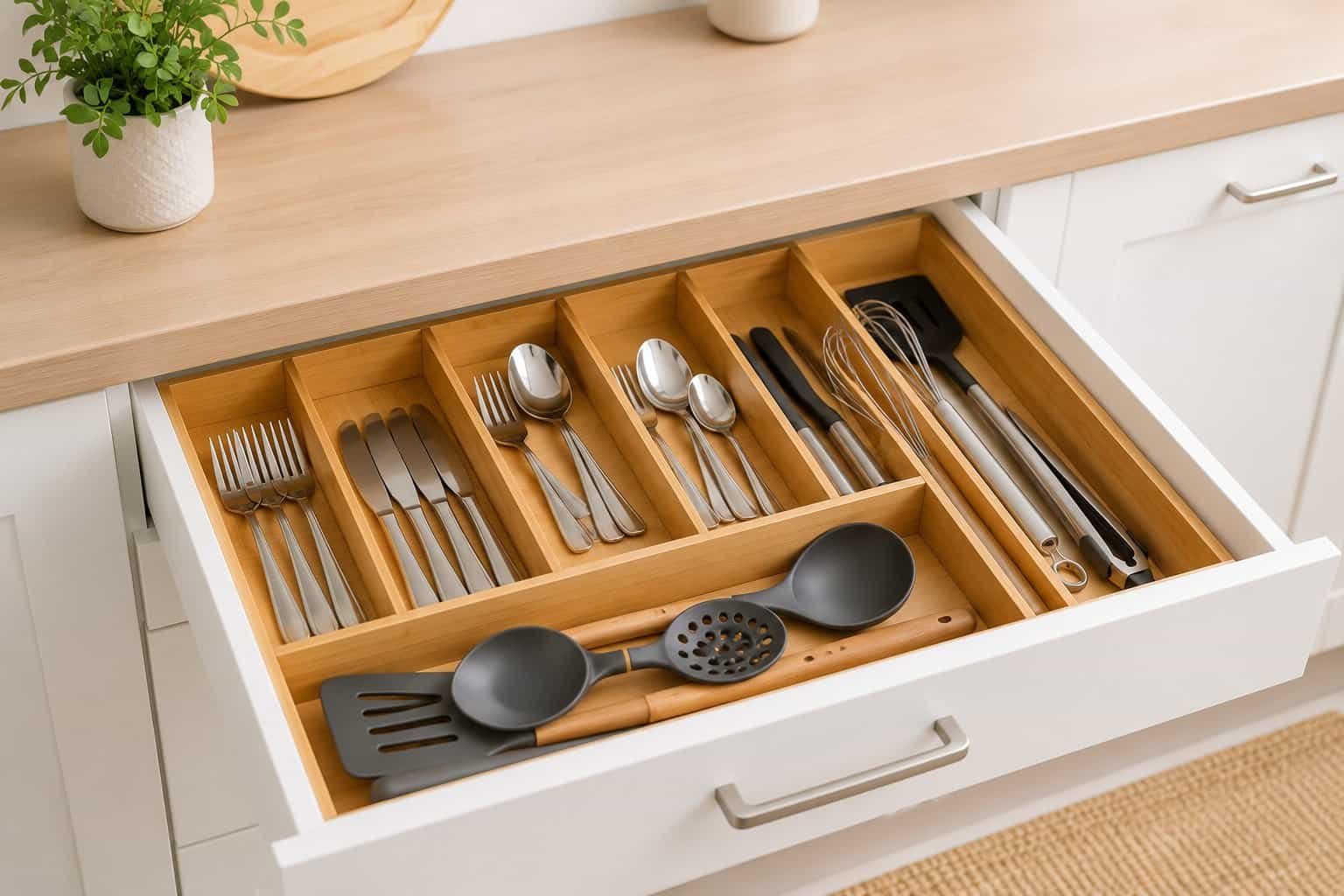
If your kitchen contains utensils and tools of different shapes and sizes, adjustable grid dividers are one of the most practical storage solutions. Adjust drawer organisers to fit your kitchen essentials, prevent overcrowding, and make it quicker and easier to find the items you use every day. Selecting the right organiser is an important step in learning how to organise kitchen drawers efficiently.
Choose the Right Drawer Organisers for Every Kitchen Drawer
If you are planning a safer and more organised kitchen, built-in knife racks are well worth prioritising. Our kitchen knife safety guide explains that storing knives loosely in a drawer increases the risk of accidental cuts, while built-in knife organisers keep blades protected, improve accessibility, and free up valuable worktop space. For additional guidance, both RoSPA’s kitchen safety resources and this in-drawer knife storage guide highlight that loose blades are one of the most preventable causes of kitchen injuries.
Combine drawer dividers with fabric or bamboo liners to create a non-slip surface that keeps utensils and kitchen tools organised and prevents them from moving every time you open or close the drawer. This not only keeps your drawers tidy but also protects delicate items from unnecessary wear.
As part of how to organise kitchen drawers, remember that different drawers serve different purposes. Matching each drawer with the right type of divider creates a more organised kitchen, improves accessibility, and makes everyday cooking more efficient.
| Drawer type | Recommended divider |
|---|---|
| Tableware | Standard tray fitted to internal width |
| Cookware | Adjustable grid or extendable partition |
| Knives | Built-in knife rack or slotted insert |
| Linen towels | No divider needed, fold and stack |
| Miscellaneous items | One small standalone tray |
| Spices | Flat insert with visible labels |
For ready-made options that fit most of these categories, our drawer organizer roundup and knife block guide cover specific products worth considering.
Depth Matters More Than People Expect
Many people overlook the value of drawer depth. Although deep drawers offer valuable storage space, they often encourage clutter because people stack items on top of one another, making it easy to overlook the tools and utensils stored at the bottom. By contrast, shallow drawers of appropriate size are far easier to keep tidy long-term.
Professional kitchen designers generally prefer a combined layout of deep and shallow drawers, rather than using just a few extra-large deep drawers to hold all items. For existing older homes where structural modifications are impossible, the renovation solution recommended by Dtdf Home and Kitchen is very applicable: sacrifice a small amount of storage capacity for long-term usability, install tiered inserts in deep drawers to build a false bottom, and improve the visibility of all items.
Common Storage Mistakes to Avoid
Finally, avoid the three most common storage mistakes: failing to measure a drawer’s internal dimensions before purchasing divider tools, hoarding duplicate identical tools such as three peelers and four sets of measuring spoons, and letting infrequently used tools occupy the prime, easily accessible space reserved for daily-use tools.
Our compiled list of 9 common kitchen mistakes expands on the shared patterns of these missteps. With the right organisation strategy, you can avoid almost every common kitchen drawer storage mistake and keep your drawers tidy, practical, and easy to use. Whether you are preparing for a new renovation or retrofitting an older home, you can find a suitable, actionable implementation method.
The core understanding of organizing kitchen drawers has never been to achieve perfection on the first day of setup.View kitchen drawer organisation as an ongoing process rather than a one-time project. Review your storage regularly, remove unnecessary items, and adjust the layout as your cooking habits and kitchenware change to keep your drawers organised and easy to use.
Frequently Ask Questions
How many dividers should I prepare?
One full-width matching divider tray is enough for a standard-sized drawer. Loose small dividers not only easily shift out of place, but also leave hard-to-use gaps. Integrated trays have far more reliable stability.
How do I choose divider materials?
Bamboo dividers require a higher upfront cost, but they are durable for long-term use and will not warp after repeated cleanings, unlike cheap plastic dividers. Invest in quality drawer organisers for your everyday tableware. Their durability and daily use can make the higher upfront cost worthwhile within one to two years.
How should knives be stored properly?
Store your knives in a dedicated in-drawer knife holder or slotted tray. Keep each blade separate and securely positioned to protect the cutting edge, prevent damage, and reduce the risk of accidental injury every time you open the drawer.Storing knives mixed in with other items is a common trigger for accidental cuts when reaching for objects, a point echoed by most professional knife-safety guidance, including OXO’s own knife safety advice.
How do I organize a drawer with no dividers?
Organise your kitchen drawer by grouping similar items together. Place cooking tools on one side and meal-preparation tools on the other so you can quickly find what you need while cooking. While this is not as tidy as using dedicated dividers, it is far better than piling items randomly with no logical order.
How often is it best to organize and streamline storage?
For most households, twice a year, once at the start of the year and once at the midpoint, is ideal. This timeframe is long enough for duplicate or unused kitchenware to accumulate, and households that skip this step will eventually end up with a drawer cluttered with odds and ends, no matter how perfect their initial storage setup was.
For details on choosing a knife rack that aren’t covered in this article, readers can check our best knife blocks guide, published on the same site.