The vast majority of households store spices in a small kitchen in a fundamentally wrong spot, and the problem goes well beyond messy labels or disorganized placement. It actually speeds up spoilage in a measurable way. The core misconception behind this is simple. Most people believe any cabinet near the stove counts as a reasonable spot for spices.
That layout is popular for a reason. Small kitchens need to save space wherever possible. And mounting a spice rack next to a stove or oven makes good use of an otherwise awkward corner.
It also photographs well, which is part of why so many home decor spreads feature the exact same setup. From a purely scientific standpoint, though. The harm here is clear cut: heat accelerates the breakdown of the volatile oils responsible for a spice’s flavor. The temperature near a stove runs well above normal room temperature. Light damages those same compounds through a completely separate mechanism. Which is exactly why most original spice packaging comes in dark glass or opaque tin.
WHY STOVE-ADJACENT STORAGE QUIETLY RUINS SPICES

This incorrect placement doesn’t create any food safety issue. It just causes a major loss of flavor over time, and plenty of people end up blaming the spice’s quality rather than where it’s been sitting. The correct storage principle is straightforward: cool, dark, and dry.
There’s a genuinely counterintuitive upside here for small kitchens specifically. Limited space actually works in a household’s favor, since there’s rarely enough room to display spices openly on a shelf just for looks. Prep counter drawers with dedicated spice compartments turn out to be extremely practical for this reason. Testing by the Dtdf Home and Kitchen team confirms flat, drawer-based storage beats standing spice racks in daily use. Since labels facing up let someone scan an entire drawer in about two seconds,. Without the label-blocking problem that standing racks create. Anyone working with tight cabinet space can pair this approach with Dtdf Home and Kitchen’s top 5 drawer organizers guide to find something that actually fits.
SMALL JARS VS. BULK CONTAINERS: THE HIDDEN COST OF BUYING BIG
Beyond location, there’s a second pitfall worth flagging: the hidden risk in bulk-size spice jars. Lower cost per gram makes bulk packaging look like an obvious win, but it carries a long-term risk that’s easy to overlook, especially for anyone cooking in a small kitchen.

The core issue is consumption rate. Most households go through ground spices far more slowly than a commercial kitchen ever would. A large-capacity jar gets opened and closed dozens of times between the first use and the last, and every one of those openings lets in air and light that degrade flavor a little more. Often, the spice sitting at the bottom of the jar has already lost noticeable flavor before even half the container is used.
Two storage formats handle this differently. Small-capacity jars built for repeated refilling let the spice get used up before it loses much flavor, fit into narrow drawers and shelf-mounted inserts, and make it easy to check remaining stock at a glance. The tradeoff is a slightly higher per-gram cost and more frequent reordering. Large-capacity bulk jars cost less per gram and mean fewer purchases overall, but they come with real downsides: flavor degradation before the jar empties, a poor fit in small kitchen storage, and a real risk of impulse-buying more variety than gets used before expiration.
For most kitchens, and small kitchens especially, the small-capacity refill approach delivers better overall value despite the higher per-gram price. Dtdf Home and Kitchen’s earlier roundup of 9 innovative storage jars was built specifically with this kind of frequent refilling in mind.
THREE SPICE STORAGE SYSTEMS FOR DIFFERENT KITCHEN LAYOUTS
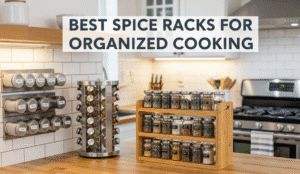
Three storage systems suit different kitchen shapes. Shelf-mounted rack inserts work well in cabinets that are deep but low, since they keep back-row jar labels from getting blocked by the row in front. Over-the-door racks mount to the inside of a cabinet or pantry door and use zero interior shelf space, which makes them a solid fit for kitchens that have already run out of shelf room elsewhere. Magnetic strip systems stick small tin spice jars directly to a metal strip on a cabinet door, though they only really work for a rotating stock of fewer than 15 varieties, their usefulness drops off fast beyond that.
One practical warning worth repeating: cabinet depth and door gap need measuring before buying any of these systems. A gap larger than about a centimeter will stop a cabinet door from closing properly, and that mismatch is the single most common reason these products get returned. For a deeper breakdown of all three systems along with specific product picks, Dtdf Home and Kitchen’s best spice rack guide covers this in more detail. Dry goods storage that pairs well with a drawer-based spice setup is covered separately in the site’s 7 must-have pantry organizers guide.
THREE DAILY HABITS THAT QUIETLY DRAIN FLAVOR
Beyond storage tools themselves, three everyday habits erode spice freshness without anyone noticing right away: keeping spices in clear glass jars sitting out on an open countertop. Leaving jar lids permanently loose for easier frequent access. And refilling new spice into an old jar without cleaning it first. None of these cause immediate spoilage. They lead instead to a slow, hard-to-detect flavor leak that persists for a long time simply because nobody notices it happening.
FREQUENTLY ASKED QUESTIONS
Do ground spices actually go bad?
They lose flavor over time rather than posing any food safety risk. Noticeable flavor loss usually sets in within 6 to 12 months. And whole spices hold their flavor much longer than ground ones. A faint, weak scent when a jar is opened is the clearest sign it’s time to replace it.
Should a spice drawer be organized alphabetically?
That works well for a large collection, since it cuts down search time considerably. For a smaller stock of around 12 jars or fewer, grouping by cuisine or use case, keeping baking spices separate from savory ones. Tends to match actual cooking habits just as effectively.
Do whole and ground spices need different storage setups?
Yes. Whole spices expose less surface area to air. So they last considerably longer and tolerate slightly worse storage conditions. Grinding whole spices in small batches as needed. Rather than buying pre-ground, extends flavor life without changing anything about the existing storage setup.
Can spices be stored in the fridge or freezer?
Most don’t need it, and condensation from temperature swings between cold and warm environments can actually shorten shelf life. Only a small number of high-oil spices, like certain chili blends in hot climates. Benefit from refrigeration, and that’s rarely relevant for most UK kitchens.
How many spices should a typical household keep on hand?
Somewhere between 15 and 25 varieties covers nearly all home cooking needs. Buying beyond that tends to just create a backlog of spices that expire before they’re used.
Anyone reorganizing their broader food storage system around. This approach can also check Dtdf Home and Kitchen’s guide to 6 smart shelf organizers. Since adjustable shelving pairs well with a dedicated spice storage setup once both are planned together.