

How to Get Rid of Bad Smells in Your Kitchen starts with understanding where unpleasant odours really come from. Many households struggle with strange, lingering smells even right after cleaning. Most people assume these persistent odours must come from unseen rotting food hidden in an out-of-sight corner, but that assumption is usually wrong. After sorting through the questions the DTDF Home & Kitchen team hears most often from readers, the pattern is clear: the vast majority of stubborn kitchen odours come from surfaces and appliances that look perfectly clean, not from hidden spoiled food. The guide below is built around the questions readers ask most, explaining the root cause of common kitchen smells, practical solutions for each, and why these odours keep returning even in kitchens that are cleaned regularly.
Why Kitchen Odors Are So Hard to Pin Down
Before getting into the room-by-room causes, it’s helpful to understand how to get rid of bad smells in your kitchen by knowing why kitchen odours behave so differently from smells elsewhere in the home. A living room smell almost always has one obvious source a pet, a scented candle or something spilled. A kitchen, however, has a dozen small odour-producing systems running at once: heat, water, grease, food residue and organic matter all interacting in warm, humid conditions. That combination creates the perfect environment for bacteria and mould to thrive, which is why kitchens can continuously generate unpleasant odours even when every visible surface has just been wiped down. Understanding these causes is the first step in learning how to get rid of bad smells in your kitchen for good.
There’s also a chemistry problem hiding underneath the cleaning problem. Many kitchen odours aren’t sitting on top of a surface where a sponge can reach them—they’re absorbed into it. Wood, unsealed grout, the rubber gaskets in appliances and even certain plastics are porous at a microscopic level. Odour molecules work their way in over weeks and months, while a quick surface wipe only removes what’s sitting on top. This is one of the biggest reasons people report that their kitchen “smells clean for an hour and then goes right back.”
1. Why Does My Kitchen Still Smell, Even Right After Cleaning?
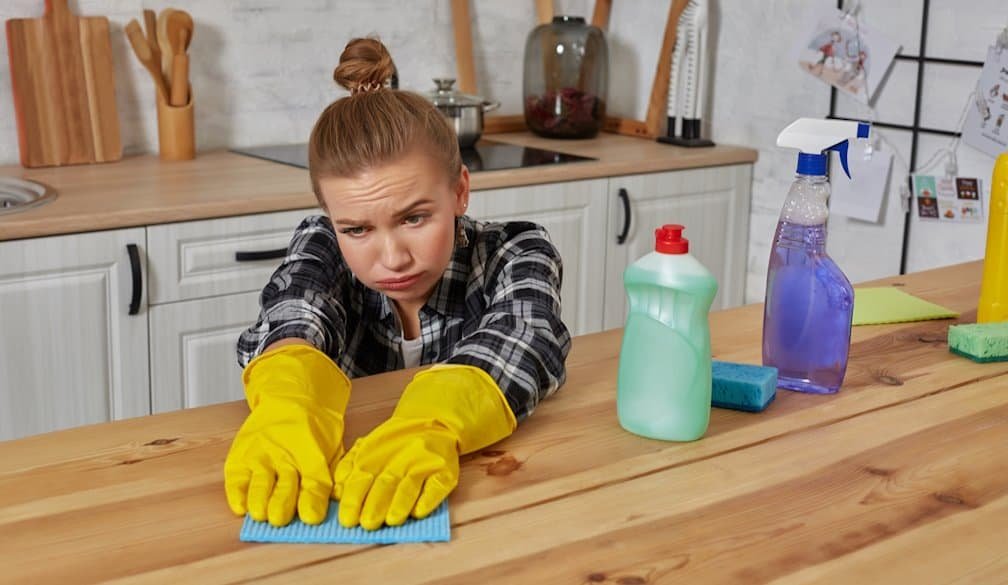
Odor sources include grease residue on range hood filters, standing moisture under sinks, and odor compounds that build up over the long term on porous or hidden surfaces such as cabinets, drain pipes, and appliance interiors. Add to that the slow oxidation of grease that seeps into gaps around stovetops, range hoods, and the undersides of cabinet bases, and it becomes clear why a quick countertop wipe-down never actually solves anything. Daily cleaning simply doesn’t reach these out-of-the-way problem areas.
It also helps to think of kitchen cleaning in two separate tiers rather than one routine. Tier one is the daily surface pass: countertops, stovetop, sink basin, visible spills. Tier two is the monthly deep-clean layer: range hood filters, appliance interiors, drain lines, and door seals. Almost everyone maintains tier one consistently. Almost no one maintains tier two on a schedule, which is exactly why a kitchen that looks spotless can still carry a smell that seems to come from nowhere. The fix isn’t cleaning harder it’s cleaning in the right layer.
2. What’s Actually Causing the Smell From My Sink Drain?
The core cause is biofilm, a layer built up from food scraps, soap residue, and bacteria clinging to the inside of the pipe, which ordinary running water can’t wash away. Biofilm forms in stages: first a thin film of organic residue coats the inner wall of the pipe, then bacteria colonize that film, and finally the colony thickens into a slimy layer that produces sulfur-smelling gas as it breaks down trapped food particles. Because it clings to the pipe wall rather than sitting loose inside it, running the tap for a few extra seconds does nothing to remove it.
Homes with a garbage disposal have it worse, since rotting food scraps get stuck in the rubber splash guard and grinding chamber and continue breaking down in place. The splash guard in particular is often overlooked, because it looks clean from above even when the underside is coated in trapped residue.
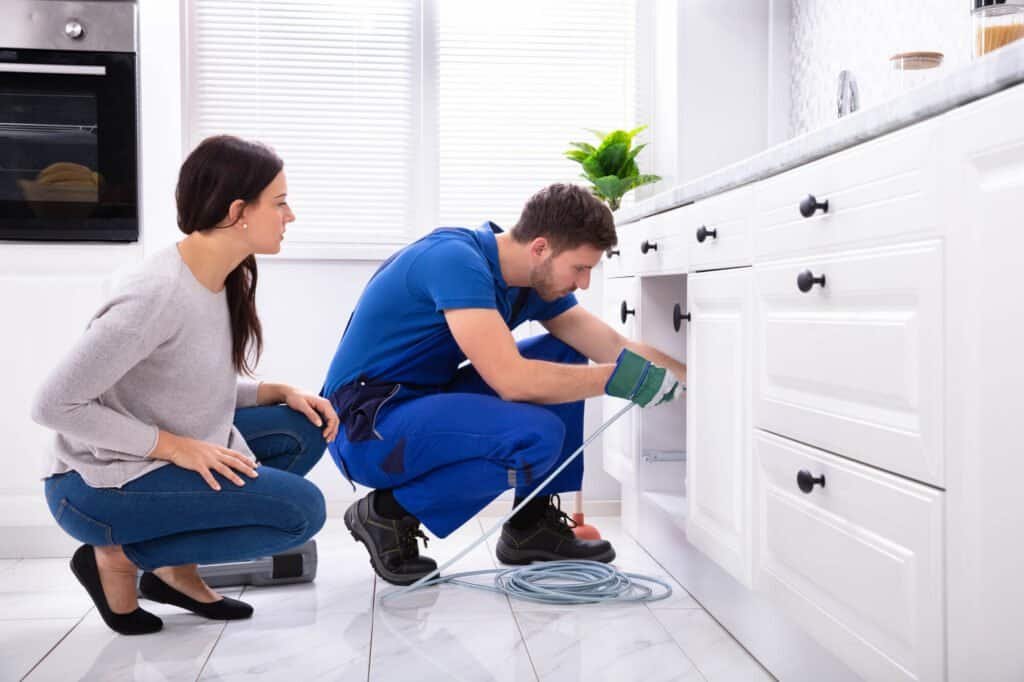
The fix is a monthly deep clean. Run ice cubes and coarse salt through the disposal, followed by a flush of diluted white vinegar. The ice and salt combination works mechanically—the ice provides abrasion against the blades and chamber walls, while the salt helps scour away loose residue. The vinegar then works chemically, using its mild acidity to break down the remaining biofilm. For a more thorough monthly clean, many homeowners also let a mixture of baking soda and vinegar sit in the drain for around ten minutes before flushing it with hot water. This helps loosen build-up further down the pipe than the disposal alone can reach and is an effective way to learn how to get rid of bad smells in your kitchen.
If your waste disposal is beyond the point where cleaning restores its performance, replacing it may be the best option. Choosing a modern, efficient unit can also help reduce lingering odours and make how to get rid of bad smells in your kitchen much easier in the long term.
3. Is the Smell Coming From the Trash Can, or Somewhere Else?
Start by ruling out the trash can itself. Confirm the lid seals properly, and that the liner fully covers the base of the can so no residue collects underneath the bag. A liner that’s even slightly too small will let liquid pool in the bottom corners of the can, and that pooled liquid is often the actual source of a smell that people assume is coming from the bag itself.
Then check the floor beneath the can, an area that’s permanently blocked off and almost never cleaned. Moving the bin occasionally to clean that hidden strip of floor cuts off a source of odor that a lot of people don’t realize exists. It’s also worth checking the underside of the can itself condensation and small drips collect there over time, and a damp base sitting against a floor is enough to sustain a faint but persistent smell on its own.
Anyone whose bin has held onto a stubborn smell for years despite regular scrubbing might get more out of replacing it than cleaning it further; this list of odor-controlling trash cans is built specifically around that problem.
4. Why Does My Fridge Smell Off With Nothing Expired Inside It?
A refrigerator’s porous plastic shelves and door bins trap odors from unsealed onions, strong cheeses, and leftovers, and that trapped smell lingers even after the food itself is long gone. Unlike a countertop, refrigerator plastic is designed to be lightweight rather than fully sealed, which means it absorbs odor compounds from anything stored directly against it for an extended period.

The standard fix—an open container of baking soda replaced monthly—works, but it takes time because baking soda relies on slow, passive adsorption. A faster option is wiping the interior walls with warm water and a small amount of white vinegar, which neutralises odours through an acid-base reaction rather than simply masking them with fragrance sprays. For shelves and bins that have absorbed smells deeply, removing them and soaking them in warm water with a splash of vinegar for 20 to 30 minutes allows the solution to penetrate further into the plastic than a quick wipe-down ever could. These simple cleaning methods are an effective way to learn how to get rid of bad smells in your kitchen without relying on artificial air fresheners.
Here’s where many people go wrong: they treat fridge odours purely as a cleaning issue and overlook worn door seals. A poorly sealed door allows warm air to enter continuously, accelerating food spoilage and creating a cycle where unpleasant smells keep returning no matter how often the shelves are cleaned. A simple way to test the seal is to close the door on a piece of paper. If the paper slides out easily without resistance, the gasket has likely lost its grip and should be replaced. Addressing both cleanliness and appliance maintenance is an important part of understanding how to get rid of bad smells in your kitchen for the long term.
Where Should I Actually Be Cleaning to Stop This From Coming Back?
Six spots people consistently miss:
- Range hood filter, removed and soaked monthly in hot water with degreaser
- Garbage disposal splash guard, wiped underneath, not just rinsed from the top
- The floor and any padding underneath the trash can
- Grime along the refrigerator door seal
- Cooking fume residue on the inside of cabinet doors near the stove
- Dish sponges and drying mats, replaced or disinfected weekly
The dish sponge deserves special mention. A wet sponge holds one of the highest bacteria concentrations of any object in a typical kitchen, and it cross-contaminates dishes, counters, and hands with a sour smell that’s hard to trace back to its source. The reason a sponge becomes such a concentrated odor source comes down to conditions: it stays damp, it’s packed with organic residue from every dish it touches, and it rarely fully dries between uses. That combination makes it one of the few household objects that can regenerate its own odor within twenty-four hours of being rinsed clean.
Rotating between two or three sponges, with full air-drying between uses, fixes this faster than most people expect. Standing a sponge upright in a holder rather than leaving it flat in a puddle by the faucet also cuts drying time significantly, since airflow reaches more of the surface. A fuller routine built around this idea is covered in this list of essential kitchen cleaning tools.
Are Commercial Odor-Eliminating Products Actually Worth Buying?
They’re best suited to long-term residual odors that have already worked their way into porous materials like wooden cutting boards or plastic containers. Activated charcoal packs placed in the fridge or under the sink work through adsorption rather than masking, and they last for months before needing replacement.
Kitchen deodorizers on the market generally split into two categories. Masking products rely on strong fragrance to cover a smell temporarily, while the odor molecules causing it are still sitting right there. The more reliable category uses biological enzymes or activated carbon to actually break down or adsorb those molecules at the source, rather than layering a second scent on top of the first. Enzyme-based cleaners are particularly effective in drains and disposal units specifically because they target the organic matter feeding the bacteria, rather than just deodorizing the air around it.
This breakdown of odor eliminators separates products that neutralize odor from ones that just mask it. As a general rule, if a product’s main selling point is a scent name rather than an active ingredient, it’s a masking product; if it lists enzymes, activated carbon, or an acid-base mechanism, it’s addressing the source.
Common Questions About Topic
Why does my kitchen smell like fish for days after cooking, even with the windows open?
Trimethylamine, the compound responsible for fishy odor, clings to grease trapped in gaps around the stovetop and doesn’t dissipate through ventilation alone. Boiling a mixture of white vinegar and water for about ten minutes neutralizes it, since the acetic acid reacts with the trimethylamine directly. Kitchen writers at Tasting Table recommend the same approach for exactly this reason.
Other Questions Worth Asking
Why does my brand-new dishwasher already smell bad after only a few uses?
Residual food scraps get caught in the filter at the base of the machine and start fermenting there. Scrubbing the filter with baking soda weekly, followed by an empty rinse cycle, generally clears it within a wash or two.
Will an old wooden cutting board hold onto smell permanently?
No. Scrubbing the surface with coarse salt, letting it sit for about fifteen minutes, then rinsing clean lifts deep residual odor even from boards used heavily for garlic or onion.
Does running the range hood for an extra thirty minutes after cooking get rid of the smell completely?
Only partly. It clears floating odor particles from the air, but it does nothing for odor that’s already adhered to surfaces like cabinet fronts or stovetop gaps, which need to be wiped down directly.
Why does my kitchen smell musty even though nothing looks visibly damp?
Hidden moisture behind cabinets, against a wall, is a common cause, and it can support mold growth without ever becoming visible. The EPA’s guidance on mold and moisture control notes that drying any wet area within 24 to 48 hours is the most effective way to prevent this in the first place. Hanging an activated carbon pack in the affected cabinet corner, and setting it in direct sunlight once a month to refresh it, helps manage the smell in the meantime.
Anyone dealing with a kitchen that stays humid or poorly ventilated in general, beyond odor specifically, may find it worth reading through this piece on common kitchen mistakes for a broader look at habits that quietly make a space harder to keep fresh.