
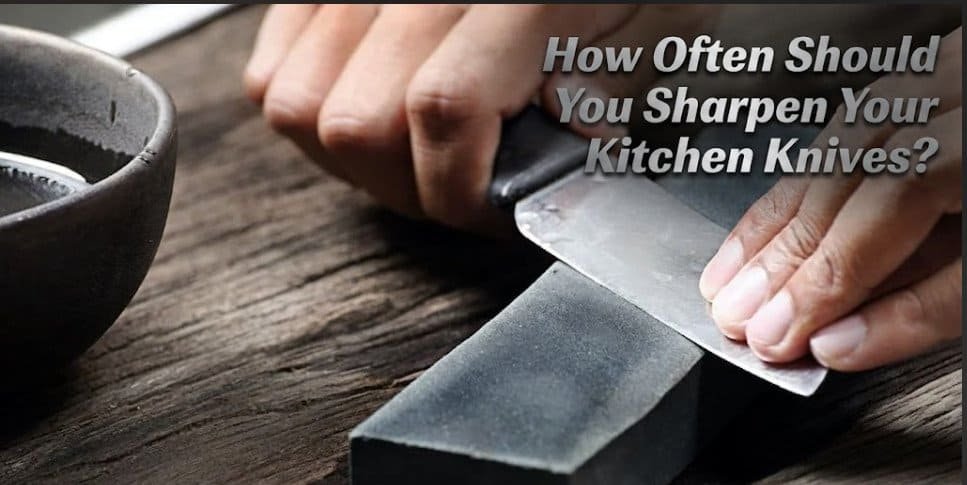
How Often Should You Sharpen Your Kitchen Knives is one of the most common questions home cooks ask when their once-sharp knives suddenly struggle to slice through everyday ingredients. Many people who cook for ordinary households have experienced the frustration of buying a new kitchen knife, only to find it becoming noticeably dull within a month. The core issue is often not the quality of the knife but how frequently it is maintained. Professional kitchens sharpen and maintain their knives weekly or even daily whereas many households never sharpen their kitchen knives at all.
So, how often should you sharpen your kitchen knives? For most frequently used home kitchen knives, a full edge sharpening every 2 to 3 months is a good general guideline, although the ideal frequency depends on how often the knife is used and the type of food being prepared. Many knife-buying guides focus on whetstones and sharpening tools but rarely explain why blades become dull or how sharpening schedules differ between home cooks and professional chefs. Understanding these differences is the key to keeping your knives sharp, safe and performing at their best.
HONING VS. FORMAL EDGE REGRINDING
Two core maintenance concepts are often incorrectly mixed up: honing and formal edge regrinding. Honing only straightens the slightly curled edge that forms during regular use, and removes no metal at all; this task usually needs to be done after every few uses. Formal edge regrinding, in contrast, requires grinding away the old, worn metal layer to create a brand new sharp cutting edge, and can only be performed infrequently with a whetstone or a professional edge regrinding system.
Many people incorrectly use honing to fix blade wear that actually requires edge regrinding, so they naturally cannot restore the knife’s sharpness. If a knife cannot even cut through the skin of a ripe tomato, that is a clear sign it needs formal edge regrinding. For anyone unsure where to start, Dtdf Home and Kitchen has published a step-by-step guide to sharpening kitchen knives safely at home that walks through the difference in practice, not just in theory.
FOUR HABITS THAT SPEED UP BLADE DULLING
There are four incorrect usage habits that drastically speed up blade dulling: 1. Cutting food directly on hard surfaces such as glass, granite, or ceramic countertops, 2. Putting knives in a dishwasher to clean them, 3. Storing knives loose in a drawer where they bump against each other, 4. Using knives for tasks outside their designed purpose, such as prying open packaging or opening cans.

Beyond these, ingredient properties, storage conditions, and cutting board material also affect sharpening frequency. Cutting hard root vegetables like butternut squash after autumn arrives, for example, pushes sharpening frequency higher than in summer, when only thin, soft fruits and vegetables are on the board. Even with proper technique, a glass cutting board can ruin a perfectly intact blade in just one month.
A SHARPENING SCHEDULE FOR EVERY HOUSEHOLD SCENARIO
Drawing on the recommended standards of professional kitchen staff and knife manufacturers, a scenario-specific sharpening schedule can be built for ordinary home use. As popular science content focused on original household kitchen tools, sharpening cycles are sorted out across all common usage scenarios first, covering four household scenarios and one commercial scenario, before moving on to the rules for special knives.
Serrated bread knives cannot be adapted to standard sharpening processes, and most household users do not need to sharpen these knives at all. They can simply be replaced every few years instead. Paring knives only perform light, precise tasks, so their edge retention runs far longer than that of chef’s knives, which handle the vast majority of daily cutting work. It’s worth repeating here: never set a unified sharpening cycle for every knife stored in a knife block, since that is the most common mistake in knife maintenance. A well-organized knife block helps keep track of which blade is which, and makes it easier to remember that each one is on its own clock.
HOW TO TELL A KNIFE HAS ACTUALLY GONE DULL
How Often Should You Sharpen Your Kitchen Knives can often be determined by paying attention to a few simple signs of blade dullness rather than relying on a single test. While the paper-cutting test is useful, it isn’t enough on its own. Three easy daily self-tests provide a more reliable indication of when a knife needs sharpening. If extra pressure is needed to cut soft-skinned fruits and vegetables such as tomatoes, bell peppers and citrus fruits, or the cut can only be completed by sawing, it’s a clear sign the blade has become dull. If a sheet of printer paper snags or tears when held in the air and cut, that also indicates the edge is no longer sharp enough. Knowing how often you should sharpen your kitchen knives also means recognising these warning signs before performance and safety begin to decline. Finally, if onion cells are repeatedly crushed while slicing, causing more eye irritation and tearing than usual, it’s another strong indication that it’s time to sharpen the blade.
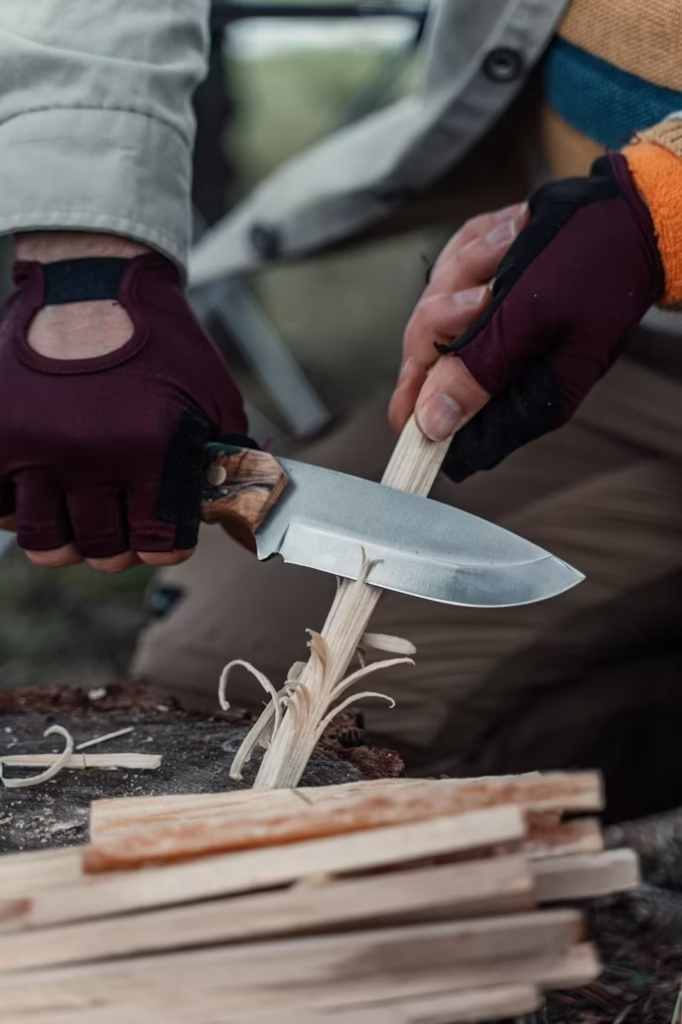
Blade dullness develops gradually over an extended period, and most people only notice their knife has become hard to use weeks after it actually went dull. Delaying sharpening is, as a result, a common problem among users, and not really a failure of attention so much as how gradual the process tends to be.
COMPARING THE THREE MAIN SHARPENING METHODS
Three mainstream blade sharpening solutions each come with trade-offs. Double-sided whetstones with different grits on each side suit users who can master the correct sharpening angle and are willing to spend time practicing; once proficient, the sharpening efficiency of this method is far higher than sending knives out for professional service. Pull-through sharpeners are beginner-friendly, but long-term use causes excessive wear to blade steel and shortens a knife’s service life. Professional sharpening services at local knife shops and farmers’ markets suit users who own high-priced or irregularly shaped knives, or who simply don’t want to learn sharpening skills themselves. Most providers charge per knife, with pickup within 1 to 2 days.
Dtdf Home and Kitchen has put together popular science content on household knife maintenance for ordinary family users, comparing the core parameters of four types of sharpening tools and services: the honing rod (daily maintenance only), the whetstone, the pull-through sharpener, and professional sharpening services, each labeled with its usage cost, required skill, suitable user group, and applicable scenario. For anyone weighing a manual sharpener against an electric one, that comparison is worth reading before buying either. Readers curious specifically about 3-stage pull-through sharpeners and whether they actually work will find a dedicated breakdown as well. For anyone who wants to sharpen their own knives with a whetstone, an exclusive in-depth operation tutorial is also available on the site.
STORAGE HABITS THAT PROTECT THE EDGE
Core knife storage maintenance breaks down into two effective solutions: knife blocks and magnetic knife strips. Throwing knives haphazardly into the same drawer as other kitchen utensils accelerates chipping and wear on the cutting edge, while following correct storage habits can extend the interval between sharpenings by several weeks or even months. This method costs nothing, takes no extra time, and is a highly cost-effective, easy-to-implement piece of routine kitchen maintenance.
A fixed sharpening schedule is, in the end, a bit of a misconception to correct. Blade wear is better judged by changes in a knife’s handling performance when cutting tomatoes and onions. Once that habit is formed, there’s no need to guess when to sharpen a knife at all.
FREQUENTLY ASKED QUESTIONS
Can a knife be sharpened too often?
Yes. Over-sharpening removes excess metal and shortens a knife’s service life, so sharpening should happen only when the edge genuinely needs it.
Are cheap knives worth sharpening?
Budget knives with decent steel are usually worth sharpening once or twice before replacement makes more sense. Very low-quality steel that dulls again within days of sharpening often isn’t worth the ongoing effort.
Does steel type affect how often a knife needs sharpening?
Yes. Hard Japanese steel holds a sharp edge for a long time but is prone to chipping, while soft Western steel is easier to sharpen but dulls more quickly.
Do serrated knives need to be sharpened the same way as straight-edged knives?
No. Serrated edges need a specialized approach entirely different from standard sharpening, and most household users are better off replacing them every few years than attempting a resharpen.
What’s the quickest way to confirm a knife needs sharpening right now?
If it can’t cut cleanly through a ripe tomato without pressing down hard or tearing the skin, that’s the fastest, most reliable test available in any kitchen.